YoForex AI educational guides
Quantitative trading explained: the method, the tests and how it differs from an EA
Quantitative trading is an approach that uses data, measurable rules and statistical tests to make trading decisions. The rules are written down, tested on historical prices, and then checked on data they did not see. An expert advisor is one tool that can run such rules automatically, but quantitative research and an EA are not the same thing.
Published · Updated · By YoForex AI Editorial Team
What is quantitative trading?
Quantitative trading is a way of making trading decisions from data, written rules and mathematical or statistical tests, rather than from judgment made in the moment. A quantitative trader writes down what triggers an entry, an exit and a position size, tests those rules on historical prices, and then checks them on data the rules did not see. The method can be as simple as one moving-average rule checked by hand, or as complex as a large statistical model run by an institution.
People often search for what is quantitative trading after hearing the term used for automated systems. The method and the tool are different things. Quantitative trading is the research, the rules and the testing. An expert advisor is one way to run a set of rules without manual clicks. You can follow a quantitative process with no automation at all, and you can run an EA that was never tested in any structured way.
A quantitative trader, the person who does this work, keeps coming back to four questions. What does the data actually show? Could the pattern have appeared by chance? What do costs do to the result? How does the rule behave when market conditions change? The answers are written down, so another person can check them.
How does a quantitative trading process work?
The process has a fixed order. Skipping a step usually shows up later as a result that looks better than it should.
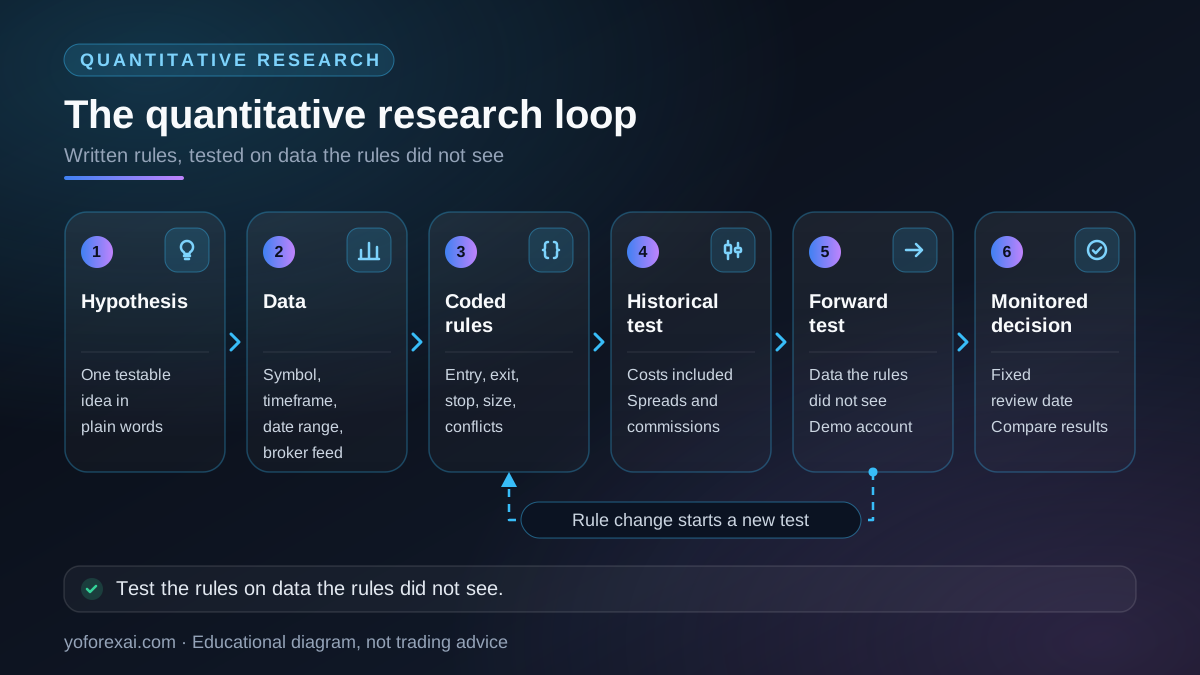
- Write a hypothesis. State one testable idea in plain words, such as a fast average crossing a slow average on the hourly chart leads to a larger move than usual.
- Choose the data. Record the symbol, timeframe, date range and the broker and server that supplied the prices. The same rule can give different results on different price feeds.
- Code the rules. Define the entry, the exit, the stop, the position size, and what happens when two signals conflict. A rule that cannot be written down is not ready to test.
- Test on historical data, with costs. Include spreads, commissions and any swap or financing cost your account charges. A result before costs is not the result you would have received.
- Test on data the rules did not see. Keep a period back, or run a forward test on a demo account, before you decide anything.
- Review on a fixed date. Compare live or demo results with the tested results, and change the rules only through a new test.
How does quantitative research differ from an EA or a signal service?
These three terms are often used as if they were the same. They describe different parts of the process, and each one carries different risks. The table compares them on the points that matter when you assess a claim.
| Point to check | Quantitative research | Expert Advisor (EA) | Signal service |
|---|---|---|---|
| What it is | A process for finding and testing rules from data. | A program that runs coded rules inside MetaTrader 5. | A feed of trade ideas sent by a provider. |
| Who writes the rules | The researcher, from a written hypothesis. | The EA author. You can see the logic only if the code or a full description is provided. | The provider. The rules are often not disclosed. |
| How it is tested | Historical data, then data the rules did not see, then a forward test. | Whatever the author shows. Ask for the full test settings and the report. | A published track record, if any. Check whether anyone independent reviewed it. |
| Audit trail | A dated hypothesis, the data version and the test log. | The trade journal and any logs the EA writes, depending on its design. | The message history, which is often limited. |
A quantitative process can produce an EA, and an EA can be built without any quantitative testing. The expert advisor guide explains how an EA runs inside MetaTrader 5, and the guide to evaluating a forex EA covers how to read a backtest before you trust it.
Signal services need the same caution. The UK Financial Conduct Authority says on its ScamSmart pages that fraudsters often promise tempting rewards, such as high returns on an investment, and that some firms pretend to be authorized. It says you can search the FCA Firm Checker to find out whether a firm or individual is authorized. Those points apply to EAs and to signal sellers as much as to any other investment offer.
How should a quantitative rule set be tested in MT5?
MetaQuotes describes the MT5 Strategy Tester as the tool for testing and optimizing trading strategies before live use. The tick mode you choose changes both the accuracy of the test and how long it takes.
The tester offers several tick modes, and they do not produce the same evidence. The evaluate a forex EA guide lists the modes and explains what each one can and cannot show, so this page does not repeat them.
MetaQuotes also describes forward testing as a repeated run of the EA on a different time period, which helps avoid fitting parameters to particular historical intervals.
Hypothetical example: a rule set is tested on 200 trades. 80 trades win, each winning trade gains 80 pips, and each of the 120 losing trades loses 40 pips. The gross result is 80 × 80 − 120 × 40 = 1,600 pips, or 8 pips per trade. If the test charges a 2-pip spread on every trade, the cost is 400 pips and the net result falls to 1,200 pips, or 6 pips per trade. The numbers are invented to show the order of the calculation. The win rate is invented. They are not a result to expect, and they say nothing about any real rule.
Who does quantitative trading, and what skills does it need?
Many individual traders, small teams and large firms do quantitative work. The work usually combines three skills: careful statistics, enough programming to test rules at scale, and the discipline to keep records. Writing down the rule before you look at the result is the habit that separates a test from a story.
You can start without code. A rule written as a checklist, tested on a few months of chart history and logged in a spreadsheet, is already a quantitative process. Coding becomes useful when you want to test many rules, many periods or many symbols without mistakes in the process.
Where do AI tools fit in quantitative trading?
An AI agent and a quantitative rule set are different designs. A rule set is fixed in advance, so the same test can be run again and give the same answer. An AI agent chooses actions from a model at run time, so it needs logs to explain each decision. The AI agents for trading page covers that difference in more detail, and the what is forex AI guide explains the wider category.
YoForex AI is our product. It is an AI-assisted chart-analysis dashboard. You provide a chart, and it returns a suggested direction, entry, stop-loss and take-profit levels with the model’s reasoning, for you to review. Treat that output as an idea to test, not as a tested rule set. Write the rule in your own words, then run the test described above before you rely on it.
What quantitative trading cannot tell you
A quantitative process shows how a set of rules behaved on the data it was given. It cannot show that the same behavior will continue. Market conditions change, brokers change spreads and execution, and a rule tuned on one period can fail on the next. Three limits matter most.
- Overfitting. A rule tuned until its historical result looks best has been fitted to the past. The check is performance on data the tuning did not use.
- Data quality. A test uses only the prices it was given. Missing bars, a different server or a short history can change the result.
- Costs and execution. Spreads, commissions, slippage and swap differ between accounts. A test shows the costs you put into it, and no more.
Risk warning. You can lose more than you deposit, depending on your broker and country. Leveraged forex and CFD accounts can lose money quickly even when a backtest looked sound, because a live market can move in ways the test did not include. Some countries restrict leveraged retail products or require specific disclosures. Check the rules that apply to you with your own regulator before you trade.
Key takeaways
- Quantitative trading is a method: written rules, data and statistical tests. It is not a product.
- An EA is one tool that can run coded rules. A quantitative process can exist with no EA, and an EA can exist with no quantitative testing.
- Test the rules on data the rules did not see, and include spreads and commissions in every result.
- Ask a signal service or EA seller for the rules, the test settings and an independent record, and check the regulator register.
- A backtest or a forward test describes past behavior. It does not guarantee future results.
Frequently asked questions
What is quantitative trading in simple terms?
It is trading that follows written rules derived from data and tested statistically. The rules say what triggers an entry, an exit and a position size, and the test shows how those rules behaved on prices they did not use to define them.
What does a quantitative trader do?
A quantitative trader forms a hypothesis, collects and checks price data, codes or writes the rules, tests them with costs included, and reviews the results on a fixed schedule. The job is as much record keeping and honest review as it is calculation.
Is quantitative trading the same as algorithmic trading?
No. Quantitative trading describes how rules are found and tested. Algorithmic trading describes how orders are placed. MetaQuotes describes algorithmic or automated trading as making buy and sell operations in the financial markets using special trading robots. Many quantitative strategies are automated, but a trader can follow quantitative rules by hand.
Do I need to code to start with quantitative trading?
No. A rule can start as a written checklist and a spreadsheet record. Code helps when you need to test many rules or long histories without making transcription errors. The EA evaluation guide explains the checks that matter for any automated rule set.
Does a quantitative strategy guarantee profits?
No. A test can show that a rule behaved in a certain way on past data. It cannot guarantee the same behavior in the future, and results can be worse than a test once spreads, slippage and changing markets are included. Keep a record of demo or paper results so you can compare them with the test. The paper trading guide explains what that record can and cannot show.
Sources and verification
Primary-source links used for the platform behavior and risk statements in this guide. Sources reviewed 9 November 2026.
- UK Financial Conduct Authority: Protect yourself from scams · Reviewed
- MetaQuotes: Algorithmic Trading, Trading Robots · Reviewed
- MetaQuotes: Strategy Testing · Reviewed