AI trading research
AI agents for trading: how they differ from expert advisors
An AI agent for trading is software in which a language model chooses steps, such as calling a data tool, reading a result or proposing an order, and records each step. An expert advisor runs fixed rules that a programmer wrote in advance. Neither type guarantees returns, and an agent can act on a wrong reading.
Published · Updated · By YoForex AI Editorial Team
AI agents for trading are programs in which a language model chooses the next step: which data to fetch, which check to run, or whether to propose an order. The agent carries out each step with a tool, reads the result and decides again. That loop is what separates an agent from a simple script, and it is also where most of the risk sits.
The term often appears in marketing copy, so it helps to define it narrowly. “Agent” describes how a system is organized, not how well it trades. A system can use a model for reasoning and still have strict limits on which tools it may call and how large an order it may send. Another system can carry the same label with no limits at all. Some writers call the same design agentic trading; the label is not a standard. Ask to see the design, not only the name.
The category overlaps with two older ideas. An expert advisor is a program written in advance with fixed rules. An AI analysis tool produces commentary for a person to act on. An agent sits between them when a model makes choices inside a workflow that a person set up. The sections below compare the three and list what to check before you trust any of them.
What are AI agents for trading?
An AI agent for trading is a system with three parts: a model that reads the current situation, a set of tools it can call, and a loop that feeds each result back to the model. The tools might fetch price history, calculate an indicator, check an account balance or send an order. The model decides which tool to use next and when to stop.
That design is different from a conventional Expert Advisor. In MetaTrader 5, MetaQuotes describes trading robots that undertake price analysis based on preset algorithms, and calls them Expert Advisors. An Expert Advisor’s logic is set in code before it runs. An AI agent makes some of those choices at run time, so the same inputs can lead to a different sequence of steps. That is why the design needs more logging and more limits.
How does an AI agent differ from an expert advisor?
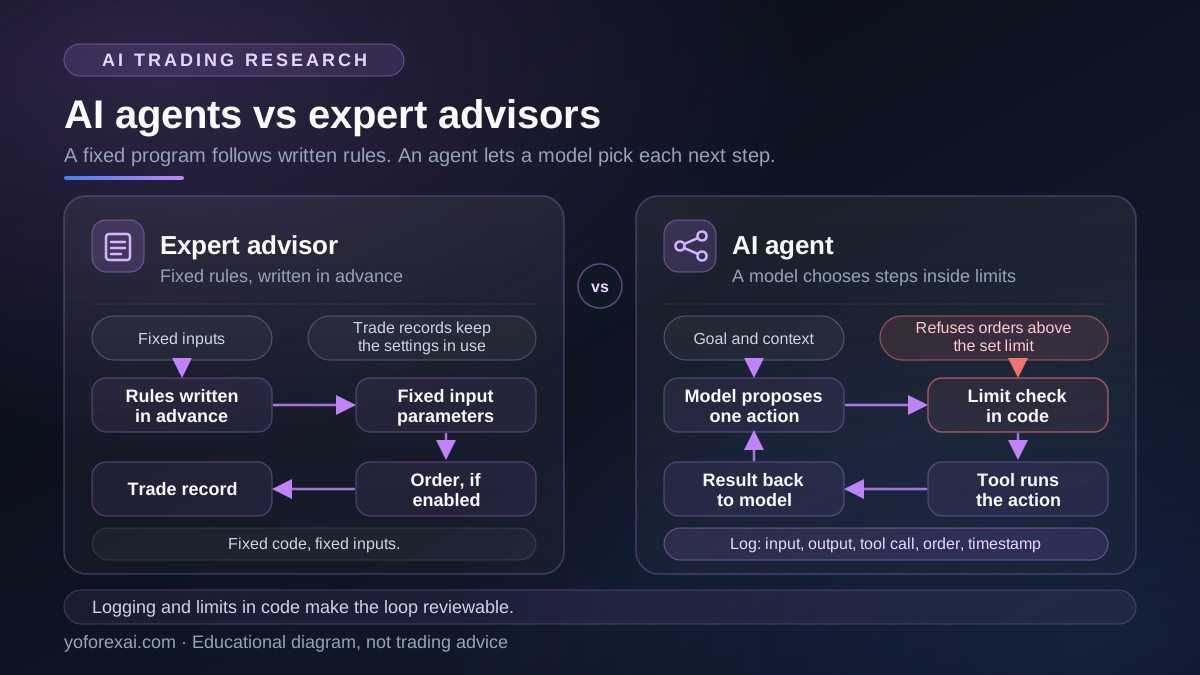
The table compares the two designs on their mechanics: who chooses each step, how tool calls and autonomy work, and what can be audited afterwards.
| Mechanic | AI agent | Expert advisor |
|---|---|---|
| Who chooses the next step? | The model, at run time, inside limits you set. | Fixed code, set before the run starts. |
| How are tools used? | Each step is a tool call, and its result goes back to the model. | Trade functions are written into the code in advance. |
| How much autonomy? | It keeps acting in a loop until it stops or reaches a limit. | Once enabled, it runs its coded rules and no further choices are made. |
| What can be audited? | Each input, model output, tool call, refusal and order, with timestamps. | Trade records and the parameter settings in use. |
| How is it tested? | Replay a saved record of each input, output and tool result. A live model does not replay cleanly in the Strategy Tester. | The Strategy Tester runs the fixed parameters on historical price data. |
| Main failure mode | A wrong step that reads as reasoned, or a tool with more access than intended. | Wrong settings, unexpected exposure, outages, or a strategy that fails in new conditions. |
MetaQuotes describes a Strategy Tester test run as one execution of an Expert Advisor with fixed input parameters on historical price data. That fits a program with fixed rules. An agent that calls a live model and live tools does not fit that pattern cleanly, so it needs a different test: a saved record of every input, output and tool result that you can review later. The MetaQuotes Strategy Testing help page covers the tester itself.
For background on the Expert Advisor side, see the MT5 Expert Advisors overview. For the broader definition of forex AI, read what is forex AI, and for the analysis-only side of the market, see AI forex trading.
Disclosure: YoForex AI is our product. It is an AI-assisted chart-analysis dashboard. You provide a chart, and it returns a suggested direction, entry, stop-loss and take-profit levels with the model’s reasoning, for you to review. This page does not describe YoForex AI as an agent. Our Private EA is an XAUUSD-focused MT5 Expert Advisor, described on the Private EA page. Check the product details on the features page before you rely on any of them.
How does an agent decide and act?
Most agent designs run the same loop. The system receives a goal and some context, such as a chart snapshot, an account status or a news feed. The model proposes one action. A tool runs that action and returns a result. The result goes back into the context, and the loop repeats until the agent stops, asks for review or reaches a limit.
The loop is where the risk enters. Each pass can add a wrong assumption, and later steps may build on it. A model can read a stale price, pick the wrong symbol or call a tool with the wrong size. None of these errors is visible unless the system records each step.
Hypothetical example: an agent is asked to review EURUSD on the 4-hour chart. Step one fetches the candles. Step two calculates a moving average. Step three proposes a buy at a stated level. The log shows that the candles were three hours old when the proposal was made. Without that record, you would see only a confident buy idea with a sensible reason attached.
What controls should an AI agent for trading have?
Controls decide what an agent can do when it is wrong. Look for these before you give any agent access to a trading account.
- A short tool list. The agent should call only the functions you name, and code should check every input before a tool runs.
- Hard position and loss limits in code. The model should not be able to raise them, and an order above the limit should be refused.
- A kill switch. One action should stop new steps and orders at once. Test it before you need it.
- Timestamped logs. Keep the inputs, model outputs, tool calls, refusals and orders for review.
- A paper or demo stage with the same limits. Run the agent with the same controls you plan to use for real money.
Be careful with any product that promises high or guaranteed returns through an AI system. The US Commodity Futures Trading Commission issued a customer advisory on 25 January 2024. It warns that fraudsters use interest in AI to tout automated trading algorithms, and it treats promises of high or guaranteed returns as a sign of fraud. Check the people and the company behind an offer, and read the fees before you pay. The CFTC release on AI scams sets out these checks.
How do you test an AI agent before using real money?
Test the agent as a system, not only its answers. Start with a written task, a fixed set of inputs and a rule for what counts as a pass. Then use four checks.
- Replay saved inputs. Store the data each run used. Rerun the same inputs later and compare the steps taken, not only the final answer.
- Test rule-based parts in the Strategy Tester. For code you control, the tester runs an Expert Advisor with fixed parameters on historical data. Treat each run as one case, not as proof.
- Check forward results separately. The tester can split a date range into a back-test period and a later forward period, which MetaQuotes says helps avoid fitting to certain time intervals. A good backtest is not a forward result.
- Run a paper or demo stage with the limits in place. Include the spreads and commissions your broker charges, and keep the misses. For the demo side, read what paper trading is.
The Strategy Testing help page covers the tester’s modes. For the analysis-versus-execution question in general, read AI forex trading. The evaluate forex EA guide lists checks that apply to any automated system.
What can AI agents for trading not tell you?
A test record shows how the agent behaved on the sample you ran. It does not show how the agent will behave in new conditions. Several things stay outside any test:
- Future news, central bank decisions or sudden market moves. The CFTC advisory makes the same point: AI cannot predict the future or sudden market changes.
- Whether the agent behaves the same after a model update. A new model version can change the steps taken even when your code has not changed.
- Your broker’s execution quality, including slippage and wider spreads in fast markets.
- Whether the agent’s reasoning is correct. A clear explanation is not evidence that the decision was sound.
Risk: You can lose more than you deposit, depending on your broker and country. The topic-specific risk here is speed. An agent can repeat a wrong step many times before you notice it, so the limits in code matter more than the model’s explanation. Check your broker terms for negative-balance protection, and read the rules that cover you, because they differ by country.
Key takeaways
- AI agents for trading are systems in which a model chooses steps and calls tools. An expert advisor runs rules written in advance.
- Agents need a log of each input, tool call and order, because the decision path can change from run to run.
- The MetaTrader 5 Strategy Tester suits fixed-parameter programs. It does not replay a live model cleanly.
- Set position and loss limits in code, outside the model, and test the kill switch before any real money is involved.
- No agent guarantees returns, and an agent can repeat a wrong step quickly. Check your regulator and your broker terms.
Frequently asked questions
Is an AI agent for trading the same as an expert advisor?
No. An expert advisor runs fixed rules that a programmer wrote and tested. An AI agent lets a model choose some steps at run time, inside whatever limits you build around it. The two can share a platform, but their logging and testing needs differ.
Can an AI agent for trading place trades on its own?
It can, if you give it a tool that sends orders. Whether it should depends on the limits in code, the logs you keep and the tests you have run. Check which tools the agent can call before you enable it on any account.
Is an AI agent for trading profitable?
Nothing here shows that any agent makes a profit. Measure any system against your own records, costs and misses included.
How is an AI agent different from a trading bot?
“Trading bot” is a broad term for any program that trades automatically, including fixed-rule scripts. “Agent” describes a design in which a model chooses the next step and calls tools. A bot can be an agent, but many bots are not.
What should I ask before I try an AI agent?
Ask which tools it can call, whether the limits are enforced in code, what is logged, whether there is a kill switch, and what changes after a model update. A provider who cannot answer these clearly is a reason to wait.
How is YoForex AI different from an AI trading agent?
YoForex AI is our product, and it is a chart-analysis tool: you provide a chart, and it returns a suggested direction, entry, stop-loss and take-profit levels with the model's reasoning, for you to review. You make the trading decision. See the features page for current plan details.
Sources and verification
Primary-source links used for the platform behavior and risk statements in this guide. Sources reviewed 9 November 2026.
- U.S. Commodity Futures Trading Commission: CFTC Customer Advisory Cautions the Public to Beware of Artificial Intelligence Scams · Reviewed
- MetaQuotes: Algorithmic Trading, Trading Robots · Reviewed
- MetaQuotes: Strategy Testing · Reviewed