YoForex AI educational guides
How to start trading forex: a seven-step, demo-first path
To start trading forex safely, learn the core mechanics, check your broker on a public regulator register, practice on a demo account, keep a trading journal, and write down your risk limits. Move to live funds only after your rules hold up in review, and use money you can afford to lose. Forex trading carries a high risk of loss.
Published · Updated · By YoForex AI Editorial Team
How to start trading forex safely
Learning how to start trading forex is a sequence of decisions, not one leap into a live account. A careful beginner learns how the market and platform work, confirms who holds the account, practices without risking money, records every decision, and only then decides whether to fund a live account. Skipping ahead is a common way to end up risking money you were not ready to lose.
The path below has seven steps and one gate. It is written for a worldwide audience, so it describes the checks to make rather than the rules of one country. Confirm the details that apply to you with your own national regulator.
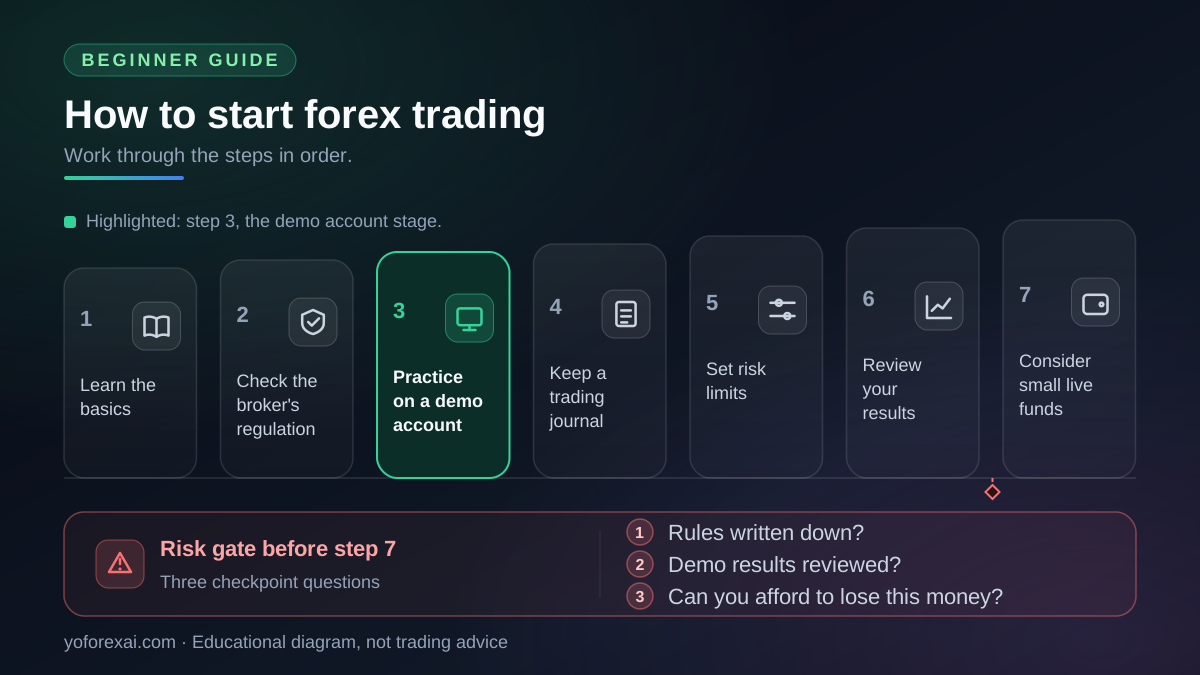
Seven steps to start trading forex
1. Learn the basics before you trade
Start with the vocabulary you will see on every screen. A currency pair is the price of one currency quoted in another, such as EUR/USD. A pip is a standard small price increment, and a lot is a standardized unit size, although brokers define contract sizes differently. Learn how the spread is charged, how a stop-loss order works, and what leverage and margin do to the amount of exposure you control.
2. Check the broker's regulation
Your broker is the firm that holds your account and processes your orders, so its legal status matters as much as its platform. Search for the firm on the public register of the regulator that licenses it in the country where it is authorized. Registers differ. The United States National Futures Association, for example, offers a free tool called BASIC that NFA members and investors can use to research the background of derivatives industry professionals. A license issued in one country does not automatically protect a resident of another, so check which regulator covers your own residence and the specific legal entity you would contract with, not only the brand name on a website.
If a firm cannot name the legal entity that holds your account, or that entity does not appear on any register you can check, stop before depositing.
3. Practice on a demo account
A demo account lets you place orders with simulated funds on the same platform and symbols you would later use live. Use it to learn order types, position sizing, the effect of spread, and how your stop and target behave. A demo account can show you workflow. It cannot reproduce every live condition, including real slippage during fast markets, the emotional weight of losing your own money, or the way your behavior changes after a losing week.
If you want to see how an analysis-based workflow looks before you commit to any tool, the YoForex AI live demo shows an example. Treat any demo or example as an illustration, not as a trading account or a verified track record. Before relying on any automated tool, read the guide to evaluating a forex EA, which explains backtests, forward tests, and the evidence to look for.
4. Keep a trading journal
Write down each trade idea before you place it. A useful entry records the date and time with timezone, the pair and timeframe, the reason for the trade, the planned entry, stop, and target, the position size, the maximum loss in account currency, and the rule you were following. After the trade closes, add the result, any deviation from the plan, and what you would check next time. The journal is the only record that separates a decision problem from a market outcome.
Hypothetical example: a trader with a 2,000 unit demo account and a 1 percent per-trade limit writes down that no more than 20 units can be lost if the stop is hit, before spread, commission, and slippage. If the trade closes against them, the journal shows whether the loss stayed inside the limit and whether the rule was followed. That is the information needed to improve, and it does not depend on whether the trade happened to win.
5. Set risk limits in writing
Decide before you trade how much you can lose on one position, how much you can lose in a day or a week, how many positions you may hold at once, and when you stop trading altogether. Many traders express the per-trade limit as a percentage of account equity. One percent is a common convention, but it is a choice rather than a guarantee of safety. Choose a figure you could accept repeatedly without changing your behavior.
Write these limits down and keep them visible while you trade. A limit that exists only in your head tends to move when a position is losing, so set it while you are calm.
6. Review your results on a schedule
Review the journal weekly. Separate three groups of trades: those that followed your rules and won, those that followed your rules and lost, and those that broke a rule. The third group matters most, because it shows where the process failed regardless of the result. Also check the costs. Spread, commission where charged, and overnight financing all reduce results, and a strategy that looks acceptable before costs may not be acceptable after them.
Do not draw firm conclusions from a few trades. A short demo history is a reason to keep practicing, not a reason to scale up.
7. Consider small live funds only after the gate
Before you fund a live account, answer three questions honestly. Are your rules written down? Have you reviewed your demo results in the journal? Can you afford to lose this money without it affecting your housing, food, debts, or other obligations? If any answer is no, stay on the demo account. Going live is a decision to accept real losses, not a reward for finishing the course.
If you do start live, start with an amount you have already decided you can lose, keep the same journal and limits, and do not add money to recover earlier losses. Changing the size of your account, the risk per trade, or the rules after a loss is one of the most common ways a careful plan turns into an uncontrolled one.
Before you deposit: a checklist
Use this table before any deposit, at any broker. It applies whether you are in a country with strict retail rules or in one with fewer restrictions. Where a row asks you to verify something, use the official source named by your regulator rather than a link from a marketing page.
| Check | What to confirm | How to verify |
|---|---|---|
| Regulation | The firm and the legal entity you would contract with are licensed by a regulator that covers your residence. | Search the regulator's public register, using the exact registered name and any license number. |
| Account terms | Leverage limits, margin close-out rules, negative balance protection, and the account currency. | Read the client agreement and the product disclosure, and ask in writing if anything is unclear. |
| Costs | Spread, commission, overnight financing, deposit and withdrawal fees, and inactivity charges. | Read the official fee schedule and calculate a typical trade with a spreadsheet before you start. |
| Platform and access | The platform you will use, the account type, and whether your login grants trading rights. | Log in on a demo account first. Investor or read-only access cannot place trades. |
| Withdrawals | How withdrawals are processed, the timeframe, and any conditions that apply. | Test with a small amount only after you understand the written process. |
| Your money | The amount you can lose without harm to your everyday finances. | Write the figure down and use only that amount for live trading. |
The MetaQuotes account authorization documentation explains that investor access lets a user view account status and prices, while the master password gives full rights to the account. Keep the two credentials separate, and never share either one. A legitimate support agent or signal service has no reason to ask for your password.
Common beginner mistakes
- Moving to a live account before a demo period has tested the workflow and the rules.
- Increasing position size after a loss to recover quickly.
- Ignoring spread, commissions, and financing when judging a strategy.
- Copying trades from a signal or a friend without understanding the entry, the stop, or the reason for the trade.
- Choosing the maximum available leverage because it is offered, not because a position needs it.
- Trusting a promise of guaranteed or unusually steady profit. No honest provider can remove the risk of loss.
Automation adds one more point to check. An Expert Advisor places orders by its own rules, so learn manual trading first. The forex Expert Advisor guide explains what an EA can and cannot do.
Risk disclosure
Forex and other leveraged products can lose money quickly. Depending on your account terms and your country, losses can exceed the amount you deposited, and margin requirements can change with market conditions. A demo result, a backtest, or an analysis tool does not guarantee how a live account will perform. This page is general educational information. It is not personal financial advice, and it does not recommend any broker, product, or trading method.
Key takeaways
- Learn the vocabulary and the platform before you place a trade.
- Confirm the regulator and legal entity on a public register before you deposit anything.
- Use a demo account to test your workflow, and treat it as a rehearsal rather than proof.
- Keep a journal and write risk limits before you trade, not after a loss.
- Move to live funds only when the rules are written, the review is done, and you can afford the loss.
Frequently asked questions
How long does it take to learn to trade forex?
There is no fixed timeline. A useful measure is behavior rather than time: whether you follow your written rules on the demo account across a sample you chose in advance, and whether your journal shows that you can explain each trade.
Is a demo account enough to decide whether to trade live?
No. A demo account is necessary for learning the platform and testing your process, but it does not reproduce real fills, slippage, or the pressure of risking your own money. Use it to decide whether you are ready to start the live stage with a small amount, not to predict how much you will earn.
How much money do I need to start?
The amount that matters is the amount you can lose without changing your life or your decisions. Brokers set their own minimums, and small accounts can face the same risks as large ones. Start with an amount you have already accepted as a loss, and do not borrow to fund trading.
Can an AI tool or a signal service replace these steps?
No. A tool can help you organize analysis, but you still need to check the regulator, understand the costs, test the workflow, and keep a record of your decisions. Treat any output as information to review, and ask what evidence supports it.
Which broker should I choose?
This guide does not recommend a broker. Start with the regulation check above, compare the account terms and costs in writing, and choose a firm that answers your questions clearly. If a firm pressures you to deposit quickly, treat that as a reason to slow down.
Is retail forex trading allowed where I live?
Rules differ by country, and some jurisdictions restrict or prohibit certain products or marketing for retail clients. Check the rules published by your own national financial regulator before opening an account, and do not rely on a broker's statement about what is allowed in your country.
Sources and verification
Primary-source links used for the platform behavior and risk statements in this guide. Sources reviewed 7 November 2026.
- MetaQuotes: Connect to an Account · Reviewed
- National Futures Association: BASIC background search · Reviewed