YoForex AI educational guides
What is paper trading? A practical guide to simulated trading
Paper trading is practicing trade decisions with simulated money, so no real capital is at risk. It helps you learn a platform, check a rule set and record decisions before committing funds. It does not reproduce every real-market condition, such as fills, slippage, spreads and emotional pressure. Treat results as a training check, not as evidence of future profit.
Published · Updated · By YoForex AI Editorial Team
Paper trading means making trade decisions in a simulated environment and tracking what would have happened, without committing real money. A trader writes down a plan, records each entry, exit and reason, and reviews the results later. Some people do this on paper or in a spreadsheet. Others use a demo account in MetaTrader 5 or another platform. Both methods help you practice. Neither one reproduces the full cost and emotion of live trading.
What is paper trading in practice?
The term comes from the older habit of writing trades on paper. Today it covers any method that tests decisions without live capital. The defining feature is that no real money is exposed to market moves. The trader decides and records, and the outcome is measured afterwards, either by hand or by software.
Paper trading is useful for three things. It shows how a market moves around the levels you watch. It tests whether a rule is clear enough to follow without interpretation. It also builds the habit of writing down the reason for every decision before the result is known. It is less useful for judging how a strategy will feel when money is at stake, and it cannot show you how the market will treat your orders.
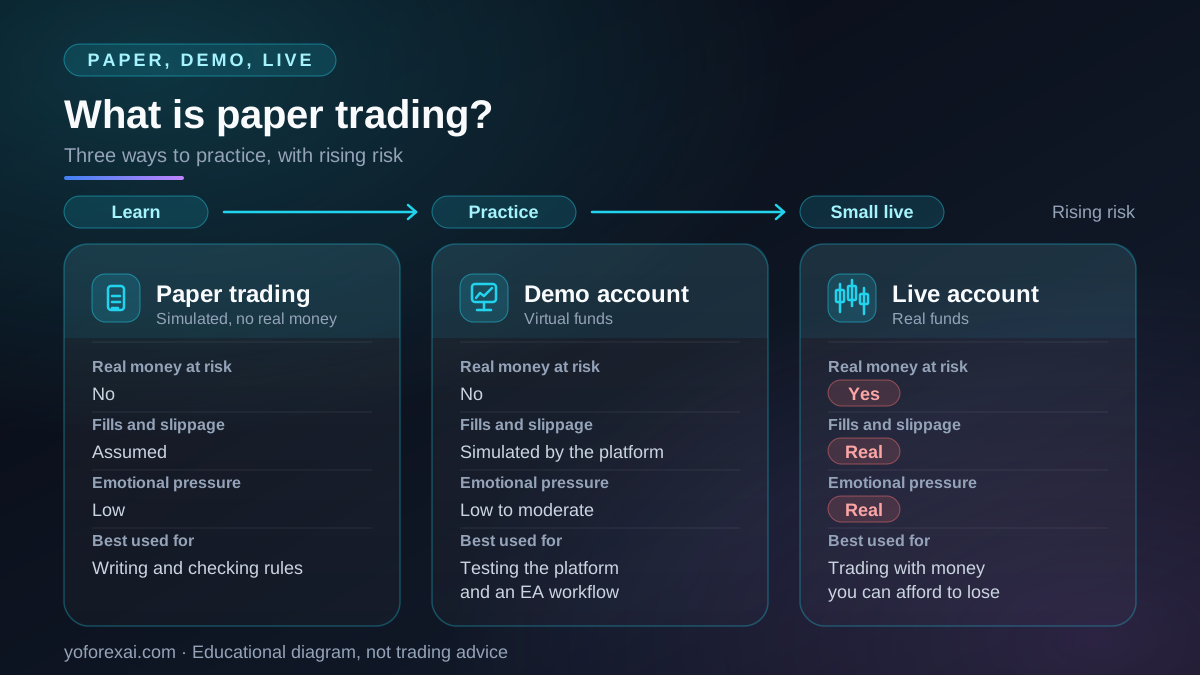
Paper trading vs demo account vs live account
These three terms are often used loosely. The table separates them by the feature that matters most when you decide what to test.
| Feature | Paper trading | Demo account | Live account |
|---|---|---|---|
| Real money at risk | No | No | Yes |
| Where orders are recorded | Notebook, spreadsheet or journal | Broker or platform demo server | Broker live server |
| Fills and slippage | Assumed by you | Simulated by the platform, and may differ from live execution | Real execution, including slippage |
| Emotional pressure | Low | Low to moderate | Real |
| Best used for | Writing and checking rules | Testing the platform and an EA workflow | Trading with money you can afford to lose |
A demo account is a practice account run by a broker or platform with virtual funds. MetaQuotes' account-opening help page states that all trading operations on a demo account involve virtual money. It describes demo accounts as a training mode without real money, which allows a trading strategy to be tested. The same page notes that a demo account cannot be expected to produce profit. A live account uses real funds, so every order carries market and account risk.
How do you paper trade a strategy step by step?
A paper test is only useful when the rules are written down before you start. The following sequence keeps the test honest.
- Write the rule in plain language. Include the market, timeframe, entry condition, exit condition, and the event that cancels the idea.
- Set limits on the sample. For example, allow one setup per session and no more than one open idea at a time.
- Record each idea before the outcome is known. Note the time, price, planned stop, planned target and the reason.
- Mark the outcome after the fact. Count missed entries, skipped signals and trades that broke your rule as carefully as the good ones.
- Review after a fixed sample, such as 30 or 50 ideas. Compare the results with the written rule, not with your memory of how the week felt.
Hypothetical example: a trader writes a rule for a breakout above the previous day high. Over two weeks she logs 40 signals in a spreadsheet, with the time, level, planned stop and whether each setup met every condition. The review finds 11 entries logged after price had already moved past the trigger. She had not noticed this timing error while watching the chart. The problem was execution discipline, not the idea. This example is hypothetical and does not show a result for any real strategy.
What can paper trading not show you?
Paper results are only as realistic as the assumptions behind them. On paper, you assume the fill price. In a platform, the software or the broker decides the fill and its timing. MetaQuotes' Strategy Tester documentation describes execution delay settings that simulate how quickly trade requests are processed. Those settings are approximations of market behavior. They are not a copy of live liquidity at the moment you need it.
- Fills and slippage: a live order can fill at a worse price, especially around news releases or during fast moves.
- Spreads, commissions and financing: costs change by symbol, broker, account type and time of day.
- Liquidity: a level that looks clean on a chart may not be easy to fill at the size you planned.
- Emotion: a missed trade or a losing streak feels different when money is involved.
- Selective memory: it is easy to skip a losing paper trade and remember only the good ones. A log prevents this.
For this reason, paper trading should be one stage of a process, not the final test. Move to a demo account to check your platform workflow. Consider a small live position only after your written rule has held up in review and you can afford to lose the capital at risk.
Does paper trading remove trading risk?
No. Paper trading removes the cash risk of the test itself. It does not remove the risk that the strategy is weak, that a short sample misleads you, or that you learn the wrong lesson from a few good weeks. Leveraged products add a separate risk. Leverage increases exposure relative to the deposit, so a small adverse move can produce a large loss. When ESMA adopted its 2018 measures on retail CFDs, its chair said the aim was to ensure that investors cannot lose more money than they put in. Rules differ by country and by product, so read the risk disclosures from your broker and check the rules set by your own regulator.
Forex and other leveraged products can cause substantial losses. A paper result is a training record. It is not a promise about the next live trade.
Where does paper trading fit in a learning path?
A practical sequence is: learn the core terms, paper trade one written rule, test the platform on a demo account, and only then consider live trading with an amount you can afford to lose. The same sequence applies if you plan to test an Expert Advisor. The EA evaluation checklist explains how to judge test evidence, and the MT5 installation and demo testing guide covers the setup steps. If you are starting from the beginning, the how to start forex trading guide lays out the broader sequence.
If you want to see an example of how YoForex AI presents its analysis, visit the live demo page. It is a recorded walkthrough of the platform workflow, not a live signal feed or evidence of performance. An AI output is one input to your review. It does not replace your written plan, your position sizing or your own judgment.
Key takeaways
- Paper trading tests decisions with simulated money, so no real capital is exposed.
- A demo account is a broker or platform practice account with virtual funds. A live account uses real money.
- Write the rule and the log before the outcome is known, then review a fixed sample.
- Paper results ignore or approximate fills, slippage, spreads, liquidity and emotion.
- Paper trading removes cash risk from the test only. Leveraged products still carry substantial loss risk.
Frequently asked questions
Is paper trading the same as a demo account?
Not quite. Paper trading is any method of recording simulated decisions, including a notebook or spreadsheet. A demo account is a practice account on a broker or platform server that uses virtual funds. A demo account tests the software and order workflow as well as the decision process, but its fills may still differ from live trading.
Does paper trading show realistic results?
It shows how your rule would have behaved under the assumptions you recorded. It can be realistic about signals and timing when the log is kept honestly. It is less realistic about fills, slippage, liquidity and your emotional response to a loss, so treat the result as incomplete.
How long should I paper trade before going live?
There is no universal number. Set a sample size before you start, such as a fixed number of setups across several market conditions, and keep the same rule throughout. A short run in one calm period is weak evidence. If the rule changes during the test, start a new sample.
Can paper trading replace a backtest?
No. A backtest uses historical data and can test many past periods quickly. Paper trading checks how the same rule behaves forward, on new data, with your own discipline in the loop. The two methods answer different questions, and each has blind spots.
Does paper trading remove the risk of leverage?
No. Paper trading can show you how a leveraged position would have moved against you, but it does not limit the loss in a live account. Before using leverage, read your broker's margin rules and your regulator's disclosures. Our forex leverage and margin guide explains how margin calls and exposure work.
Sources and verification
Primary-source links used for the platform behavior and risk statements in this guide. Sources reviewed 7 November 2026.
- MetaQuotes: Strategy Testing · Reviewed
- MetaQuotes: Open an Account · Reviewed
- European Securities and Markets Authority: ESMA adopts final product intervention measures on CFDs and binary options · Reviewed