YoForex AI educational guides
What is forex AI? How AI analyzes forex markets and where it fails
Forex AI is software that applies artificial intelligence, such as statistical models, machine learning or language models, to forex data. It can summarize charts, flag scenarios and send alerts. It does not forecast markets reliably or guarantee profit, so its output needs human review, recorded testing and your own risk limits.
Published · Updated · By YoForex AI Editorial Team
What does forex AI mean?
Forex AI is a broad label for forex software that uses artificial intelligence somewhere in its process. The phrase covers very different products. A simple rule-based indicator can be sold as AI. A serious model can be described in one vague sentence. The useful question is not whether a product says AI. It is which data the software reads, what method it uses, what it produces, and who makes the final decision.
In practice, forex AI usually means one of three things: a model that reads prices or chart images and produces an analysis, a program that places or manages orders automatically, or a service that sends alerts built by software. Some products combine all three. This guide explains how the category works so you can label each part before you evaluate it. The companion page on AI forex trading covers how to test a tool in practice.
What are the main types of forex AI products?
Four product types appear most often. They look similar on a sales page but do different work, and they fail in different ways.
| Category | What it does | Typical output | Main limitation |
|---|---|---|---|
| Signal services | Sends alerts or trade ideas produced by a model, a person, or both. | A pair, a direction, and levels, often with little reasoning. | Alerts can arrive late, and the full method is often hidden. |
| Chart-reading tools | Reads price data or a chart image and describes what it sees. | A written analysis, scenarios, and levels for review. | Can misread the scale, the timeframe, or the time shown on the chart. |
| Expert Advisors (EAs) | Runs programmed rules inside MetaTrader and may place or manage orders. | Orders, position changes, and entries in the platform logs. | Often fixed rules. Some products labeled AI follow the same kind of logic as older EAs. |
| Market scanners | Filters many symbols against a set of conditions. | A list of candidate symbols. | A filter can be wrong or out of date. A shortlist is not a decision. |
MetaQuotes describes the Expert Advisor model in its algorithmic trading documentation. It explains that these programs analyze prices using preset rules and can execute trades. That is a rules-based description, and it applies whether or not a vendor adds the word AI. For the difference between EAs and alert services, read forex signals vs Expert Advisors.
How does a chart-reading model work?
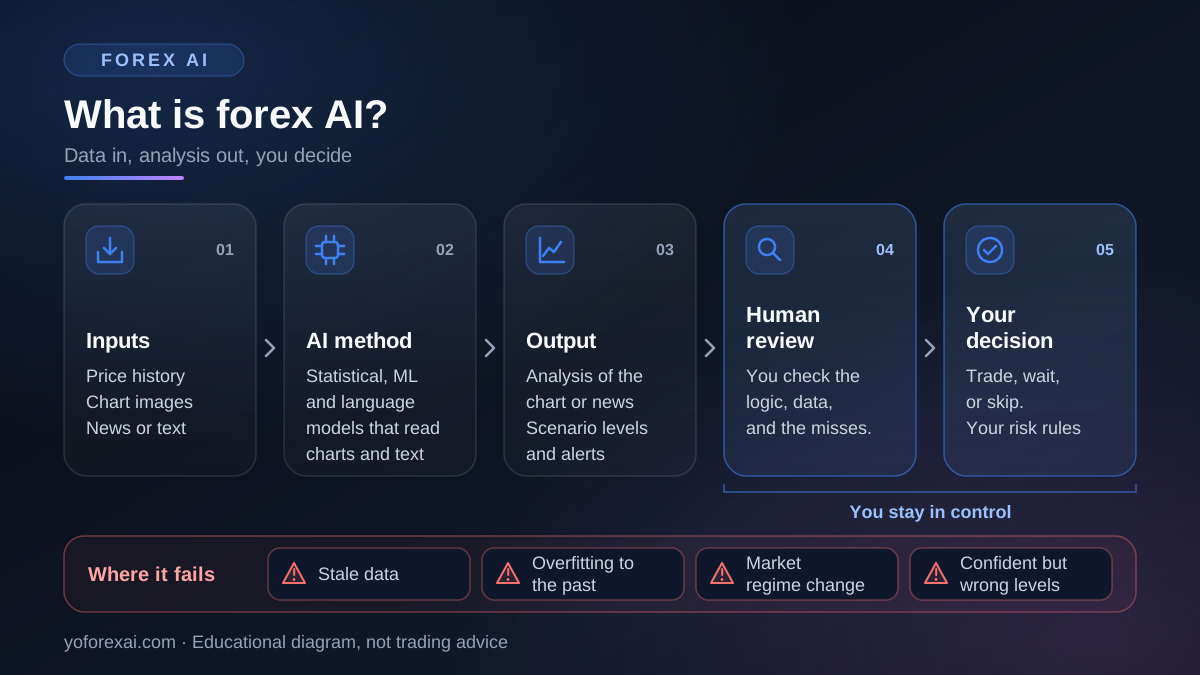
A chart-reading tool follows a simple chain, even when the internal model is complicated. It takes inputs, applies a method, produces an output, and then waits for a person to act or ignore it. Each link can fail, so it helps to inspect them one at a time.
- Inputs. Common inputs are price history (open, high, low and close values for each bar), a screenshot of a chart, and sometimes news headlines or economic calendar text. The tool knows only what it receives. A screenshot with the time axis cropped out gives it no reliable time.
- Method. Statistical and machine-learning models look for patterns in numerical data, often from past examples. Language models can read a chart image or a block of text and describe it in sentences. Many products combine both, and the vendor may not explain which part produced a given sentence.
- Output. Typical outputs are a written analysis, scenario levels such as a zone where a view would change, and an alert. An output can sound certain even when the input was weak. Treat the wording as a claim to test, not a finding.
- Human review. You check the timestamp, the symbol, the levels against the live chart, the assumptions, and what would invalidate the view. Only after that do you decide anything.
Hypothetical example: a tool reports that EUR/USD on the 4-hour chart is “constructive above 1.0850” and lists a level below it where the view fails. Before you use that answer, confirm that the chart screenshot shows the current bars, that 1.0850 is a level you can actually see, and that the tool gives a consistent answer when you send the same screenshot again. A single fluent answer does not show the tool is correct.
Where does forex AI fail?
Forex markets change, and a model is only as current as its data and its training period. Four failure patterns recur. Each one can look like a good answer until the market moves.
- Stale data. A delayed feed, an old screenshot, or a cached result can describe a market that has already moved. Check the timestamp before reading the level.
- Overfitting to the past. A model that fits historical data closely may have learned noise. Good results on the data used to build it do not show that it will work on new data.
- Market regime change. Volatility, central bank policy, or liquidity can shift. A tool built on one regime may behave poorly in another, and it may not warn you when that happens.
- Confident but wrong levels. Support and resistance levels generated by software can be placed on noise, on the wrong scale, or on a price the broker does not quote. A precise number is not evidence that the level matters.
- News spikes and thin liquidity. Scheduled releases and sudden events can move price far beyond a model's expected range. Spreads can widen sharply in thin markets. Software that does not account for these conditions can produce plans that cannot be filled as drawn.
What forex AI cannot do
No forex AI tool can guarantee profit, know future news, remove trading risk, or replace your own risk limits. A tool that claims otherwise is describing a product you should not trust. The AI forex trading page explains each limit and shows how to test a tool against it.
The US Commodity Futures Trading Commission (CFTC) published a customer advisory on 25 January 2024 about AI-related investment claims. Its press release is at CFTC Customer Advisory Cautions the Public to Beware of Artificial Intelligence Scams. The release says scammers claim AI-created algorithms can generate huge returns, and it treats high or guaranteed return claims as red flags of fraud. It also covers algorithms that place trades and algorithms that send buy and sell signals to subscribers.
Who sells forex AI, and what is YoForex AI's role?
YoForex AI sells AI forex analysis software. This page is written by a company with a commercial interest in the category, and you should weigh it that way. Our plans, shown on the features and pricing page, include a free plan with 5 AI analyses per day and access to free AI models (Mistral, Claude Haiku, DeepSeek). The same free plan lists “No multi-AI consensus” as a limitation. Confirm current paid prices there before you buy. Our alerts are described as delivered through the Dashboard, Telegram and WhatsApp. Apply the checklist below to our product as you would to any other.
Checklist for evaluating any forex AI tool
- Which of the four categories is this: signal, chart reading, EA, or scanner? Products often mix them.
- What exact data does it use, and how old is that data when you see the output?
- Does every output include a timestamp, the symbol, the timeframe, and an invalidation level?
- Can you see the rules or the method, or at least the assumptions and the failure modes?
- Can you record its outputs and check them later against what the market did?
- Does the vendor state its costs, its limits, and where its results come from, without guaranteed returns?
The AI forex chart analysis guide gives a reusable prompt, an input checklist and a validation process for the chart-reading case.
Risk disclosure
Forex trading, and especially trading with leverage, can produce losses quickly and can exceed the amount you deposit. Leverage limits, margin rules and investor protections differ by country and by broker, so check the rules that apply to you with your national regulator. Forex AI does not change that risk. An analysis, an alert, or an EA is an input to a decision you still have to make and carry out.
Key takeaways
- Forex AI is a label for several product types, including alert services, chart-reading tools, Expert Advisors and scanners.
- A chart-reading tool depends on its inputs. Check the timestamp, the symbol, and the screenshot before you read a level.
- Common failure modes are stale data, overfitting, regime change, and confident but wrong levels.
- No forex AI tool can guarantee profit or remove trading risk. Guaranteed-return claims are a fraud warning sign.
- Test any tool by recording its outputs and comparing them with what happened, including the misses.
Frequently asked questions
Is forex AI the same as a forex robot?
Not always. A forex robot usually means an Expert Advisor that runs in MetaTrader and may place orders. Forex AI is broader. It can describe a chart, send an alert, or scan symbols without placing any trade. Some robots use machine learning; many others follow fixed rules. Read the product documentation to see which one you are buying.
Can AI predict forex prices?
No tool can predict forex prices with reliable accuracy, and no vendor should promise that it can. Markets respond to events that no model has seen in its data. The more useful goal is a clear, testable analysis that you can check against later price action, with the failures recorded as carefully as the successes.
Is forex AI legal to use?
The rules for forex firms, brokers, and investment products differ by country. The CFTC has warned the public about AI-related investment fraud in the United States, as described above. Check your own national regulator's warnings and register before you pay for any service or deposit funds with a broker.
Do I need programming skills to use forex AI?
Chart-reading tools generally need only a browser or app and a chart you understand. Expert Advisors need installation in MetaTrader 5 and careful testing on a demo account. Neither requires you to write code, but both require you to read documentation and check logs.
Does forex AI work on every currency pair and timeframe?
Not necessarily. Output quality depends on the data, the symbol and the timeframe. A tool that looks sensible on one pair can be unreliable on another. Test each symbol and timeframe you plan to use, and do not assume that a result on one instrument transfers to another.
What should a forex AI output include?
At minimum, a timestamp, the symbol, the timeframe, and an invalidation level. Without them you cannot check the output later. Testing methods are covered on the AI forex trading page.
Sources and verification
Primary-source links used for the platform behavior and risk statements in this guide. Sources reviewed 7 November 2026.
- U.S. Commodity Futures Trading Commission: CFTC Customer Advisory Cautions the Public to Beware of Artificial Intelligence Scams · Reviewed
- MetaQuotes: Algorithmic Trading, Trading Robots · Reviewed