YoForex AI educational guides
Forex trading strategies: rules, main types and how to test them
A forex trading strategy is a written set of rules for when to enter, when to exit, how much to risk and what to trade. Common types include trend, range, breakout, carry and news strategies, and each assumes a different market condition. Until its rules are tested on past data and on a demo record, a strategy is a hypothesis.
Published · Updated · By YoForex AI Editorial Team
Forex trading strategies are the written rule sets that traders use to decide when to open a trade, when to close it, and how much capital to put at risk. It does not predict price. The same pair can behave as your rules expect on one set of charts and not on the next, which is why the written rules matter more than any single trade.
This guide defines the parts a strategy needs, sorts the main types, and explains how a rule set is tested before anyone risks money on it. A strategy is different from an indicator and from a signal. An indicator, such as a moving average, is one input. A signal is an alert that a trade may be open. A strategy is the full rule set that connects those inputs to an entry, an exit and a position size.
What is a forex trading strategy?
A forex trading strategy is a set of rules that defines a trade from start to finish. Before a trade is taken, the rules answer four questions: what to trade and on which timeframe, when to enter, when to exit, and how much to risk. If any of those answers is left to judgment on the day, the strategy is only partly written. Written rules are what let you check later whether you followed them.
The CFTC Futures Glossary describes directional trading as trading strategies designed to speculate on the direction of the underlying market. Forex strategies are usually in that family, but the glossary definition does not say which rules a strategy should contain. That part is the trader's job, and it is the part most often left vague.
What separates a strategy from a hunch is repeatability. Someone else should be able to read the rules and reach the same decisions on the same chart. A tool that reads a chart and suggests a direction gives you an input. It is not a strategy until its entry, exit and sizing rules are written down and tested. That applies to an AI chart read as much as to a hand-drawn line. The output of YoForex AI (our product) is one input you can review, not a tested strategy in its own right.
What rules does a forex trading strategy need?
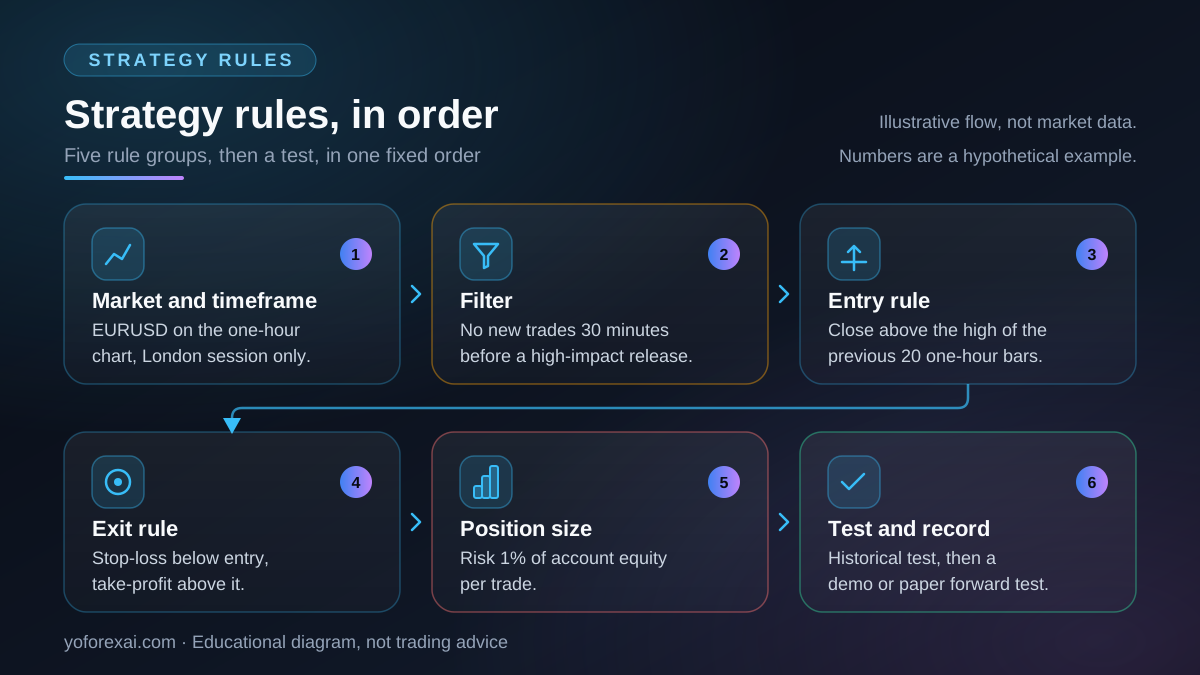
Most written strategies contain five groups of rules. The table shows each group with a hypothetical example. The numbers are round and made up for illustration. They are not a recommendation.
| Rule group | Question it answers | Hypothetical example |
|---|---|---|
| Market and timeframe | What is traded, and on which chart? | EURUSD on the one-hour chart, during the London session only. |
| Filter | When do you stay out? | No new trades for 30 minutes before a scheduled high-impact release. |
| Entry | What must happen before you open a trade? | Price closes above the high of the previous 20 one-hour bars. |
| Exit | When do you close, win or lose? | Stop-loss 30 pips below entry. Take-profit 60 pips above entry. |
| Position size | How much capital is at risk? | Risk 1% of account equity per trade. On a hypothetical $10,000 account, that is $100. |
Every row needs a number, a condition or a named source, or it cannot be checked. The filter row is the one most often left out. A strategy that trades through every scheduled release can look sound on past charts and still fail on the day of a rate decision.
What are the main types of forex trading strategies?
Most forex strategies fall into a few families. Each family is defined by the market condition it assumes. These labels are common in trading education, but no official standard defines them. Check how a source uses each term before you copy its rules.
| Type | Market condition assumed | Typical entry idea | Main failure |
|---|---|---|---|
| Trend | Price moves in one direction for a sustained period. | Enter in the direction of the larger move after a pullback. | Sideways markets, where repeated entries are stopped out. |
| Range | Price moves between a support area and a resistance area. | Buy near support and sell near resistance, with a stop beyond the range. | A breakout that does not return inside the range. |
| Breakout | Price leaves a consolidation, such as a range or a chart pattern. | Enter when a close lands beyond the boundary. | A false breakout that reverses within a few candles. |
| Carry | The interest-rate gap between two currencies stays broadly stable. | Hold the higher-yielding currency against the lower-yielding one. | Exchange-rate moves that are larger than the interest earned. |
| News | A scheduled economic release creates a burst of volatility. | Trade a set rule around the release time, or stay out. | Wider spreads and slipped fills, with price moving either way. |
How do trend, range and breakout strategies differ?
A trend strategy assumes that a move, once established, tends to continue for longer than a single bar. Its rules usually wait for a pullback and then enter in the direction of the larger move.
A range strategy assumes that price stays between a support area and a resistance area. It buys near the lower edge and sells near the upper one. The stop has to sit beyond the range, because a close outside it suggests the range has changed. The support and resistance guide explains how to mark those areas as zones rather than single lines.
A breakout strategy waits for price to leave a consolidation and enters when a close lands beyond the boundary. Its main problem is the false breakout, where price closes outside the boundary and returns inside within a few bars. The chart patterns guide covers close-based confirmation rules for breakouts in more detail.
What are carry and news strategies?
A carry strategy holds the currency with the higher interest rate against the one with the lower rate, and earns the difference while the position is open. Exchange-rate moves can be larger than the interest earned, so the trade can lose money even while the gap stays the same. Whether your broker pays or charges overnight financing on an open position depends on its terms, so read those terms before you hold a trade past the daily rollover.
A news strategy trades around a scheduled economic release, such as a central bank rate decision or an employment report. Its rules set a time, a direction and a stop, or they set a rule to stay out. Spreads can widen and fills can slip around a release, so the price you planned for may not be the price you get. Use the official release calendars for dates.
How do you test a forex trading strategy?
Test the rules before you trade them with money. Write them in a form that can be followed without judgment, apply them to historical data, and record every result, including the ones you would rather not count. The MetaQuotes help page on the Strategy Testing topic describes how MetaTrader 5 runs an Expert Advisor once on history data using set parameters. That is a useful first check. It does not show how the same rules behave on a live feed, with live spreads and slippage.
The same page describes a Math calculations mode, which does not perform margin control and is meant only for rough estimates.
After a historical test, run a forward test on a demo account or a paper record. The paper trading guide explains what that step can and cannot show. For a fuller checklist on Strategy Tester settings and the questions to ask about an Expert Advisor, read the evaluate a forex EA guide.
What can a forex trading strategy not tell you?
A written strategy can show what its rules would have done in the past. It cannot show what the market will do next. These limits apply to every type above:
- Market conditions change. A strong historical result may come from a period when the market behaved the way the rules expected. The rules can fail when volatility, session activity or the relationship between pairs shifts.
- Optimized settings fit the data they were chosen on. A parameter set picked for the best result on one period needs a test on data the optimization did not use.
- Costs change the outcome. Spreads, commissions, overnight financing and slippage can turn a rule that looks profitable on paper into a loss in practice.
- Symbols differ between brokers. The same name can carry different contract sizes, digits or trading hours, so a rule tested on one symbol may not transfer to another.
- Past performance is not a reliable guide. The UK Financial Conduct Authority makes this point in its guidance on price graphs, which says that past performance is not a reliable indicator of future results.
Risk warning. You can lose more than you deposit, depending on your broker and country. Margin and leverage magnify both gains and losses. A strategy with a stop can still lose more than planned when price gaps past the stop or a fill slips. The forex leverage and margin guide explains how those terms work. Check the protections that apply to you with your own regulator.
Key takeaways
- A forex trading strategy is a written rule set covering the market, the filter, the entry, the exit and the position size.
- An indicator is one input and a signal is an alert. The strategy is the complete rule set that uses them.
- Trend, range and breakout strategies assume different market conditions, and each fails in a predictable way.
- Carry and news strategies carry costs and risks that written rules do not remove.
- Test the rules on history, then forward test them, and treat any historical result as a hypothesis.
Frequently asked questions
What is the difference between a forex trading strategy and an indicator?
An indicator, such as a moving average or the MACD, is one calculation from price data. A strategy uses one or more indicators, or none, and adds rules for entry, exit and position size. An indicator on its own does not say when to trade or how much to risk.
Is there a best forex trading strategy?
No single strategy is best across all markets. The right type depends on the market condition, the timeframe and the risk you can accept. Be cautious of any source that names one strategy as reliable without showing its rules, its test period and its sample size.
Is an Expert Advisor a forex trading strategy?
Not by itself. An Expert Advisor is a program that can place and manage trades automatically. The strategy is the set of rules the program follows. An Expert Advisor can carry out a strategy, but its code does not show whether the rules are sound. The forex expert advisor guide explains the difference in more detail.
Are forex signals strategies?
A signal is a trade alert. It usually shows a trade, not the rules that produced it, so you cannot test it as a strategy unless the provider publishes its entry, exit and position-size rules in full.
How many strategies should a beginner test?
One. Write the rules for a single strategy, test it on history, then forward test it on a demo or paper record. Adding a second strategy before the first is tested makes it hard to tell which rule produced which result.
Sources and verification
Primary-source links used for the platform behavior and risk statements in this guide. Sources reviewed 9 November 2026.
- U.S. Commodity Futures Trading Commission: Futures Glossary · Reviewed
- UK Financial Conduct Authority: Understanding price graphs · Reviewed
- MetaQuotes: Strategy Testing · Reviewed