YoForex AI educational guides
What is leverage in trading? Forex margin explained with worked examples
Leverage in trading lets you control a position larger than the cash in your account. Margin is the deposit your broker holds to keep that position open. Position size divided by leverage gives the required margin, and a loss reduces equity, which lowers the margin level. Limits and close-out rules vary by broker and jurisdiction.
Published · Updated · By YoForex AI Editorial Team
What is leverage in trading? A plain definition
Leverage is a ratio that lets a trader open a position larger than the cash held in the account. At 1:100, each unit of your own money can support up to 100 units of market exposure, before the broker's other requirements are considered. Leverage is not a fee. Costs such as spreads, commissions, and overnight financing still apply to the position.
Leverage works in both directions. A given price move produces a larger gain or loss relative to your deposit than it would without leverage. That is the reason leverage deserves a careful definition before it is used on a live account.
Margin is different from leverage. Margin is the portion of your balance that the broker sets aside as collateral for open positions. It is not a fee and it is not a loss. The margin set aside for a position is released when that position closes. Many beginners confuse the two terms, but they answer different questions: leverage describes how much exposure a deposit can support, and margin describes how much of your deposit is currently committed.
How is required margin calculated?
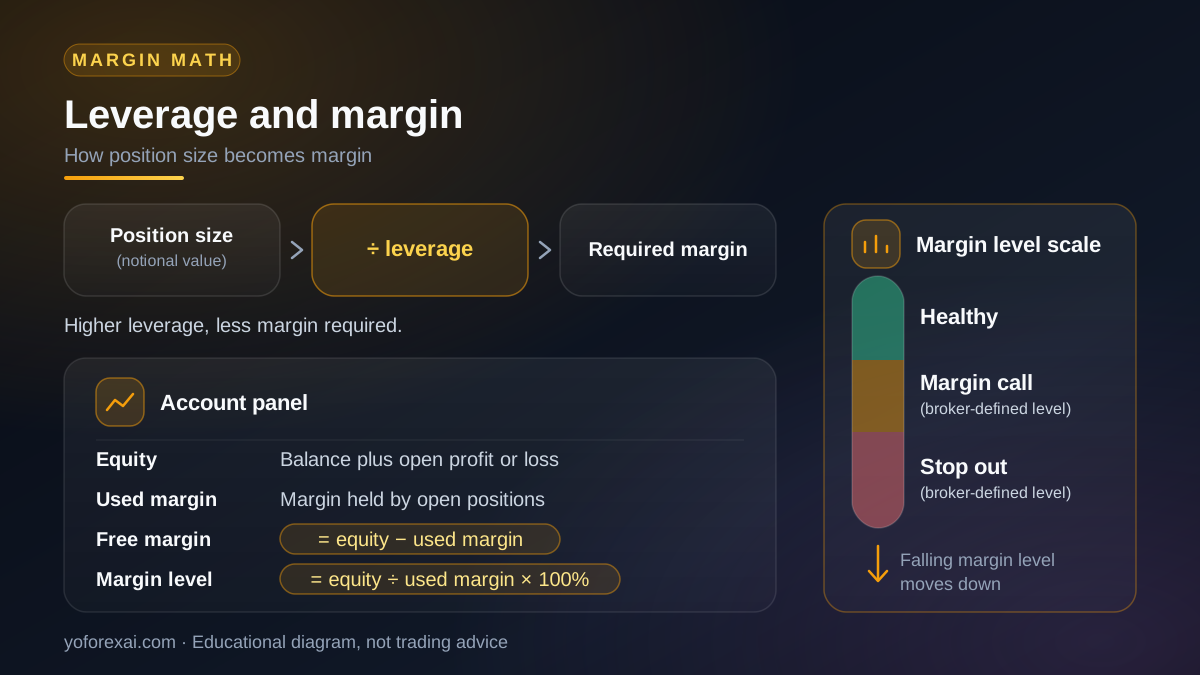
MetaQuotes documents the retail forex margin formula as volume in lots multiplied by contract size, divided by leverage. Its example works out one lot of EURUSD at 1:100 as 1,000 EUR of margin, because 1 × 100,000 ÷ 100 = 1,000. The same calculation in your own terms follows the steps below. Convert the result to your account currency at the current exchange rate.
Notional value   = lots × contract size × price
Required margin  = notional value ÷ leverage
Free margin      = equity − used margin
Margin level     = equity ÷ used margin × 100%
The required-margin formula comes from MetaQuotes. The equity, free margin and margin level definitions are general conventions, and your broker's account specification sets the exact rules.
Equity is your balance plus or minus the floating profit or loss, adjusted for credit, commission, and any blocked funds as your broker defines them. Used margin is the total margin held for open positions. Brokers decide whether floating profit, floating loss, or both are counted in equity, so read your account specification before relying on the figure.
A worked example with hypothetical numbers
The figures below are hypothetical. They use a simple USD account and one standard lot of EURUSD at 1.1000 so that each step can be checked. They do not reflect any broker's terms, and they are not a suggestion to trade at this size. The purpose is to show how a single position changes the account when price moves against it.
| Step | Calculation | Result |
|---|---|---|
| Equity at the start | Hypothetical deposit | $2,000 |
| Notional value of 1 lot | 100,000 EUR × 1.1000 | $110,000 |
| Required margin at 1:100 | $110,000 ÷ 100 | $1,100 |
| Free margin at the start | $2,000 − $1,100 | $900 |
| Margin level at the start | $2,000 ÷ $1,100 × 100% | 181.8% |
| Loss from a 100-pip move against the trade | 1.1000 to 1.0900; 100 pips × $10 per pip | −$1,000 |
| Equity after the loss | $2,000 − $1,000 | $1,000 |
| Margin level after the loss | $1,000 ÷ $1,100 × 100% | 90.9% |
| Free margin after the loss | $1,000 − $1,100 | −$100 |
The position's dollar loss depends on the lot size and the price move, not on the leverage. A 1 lot position loses $1,000 on a 100-pip move whether the leverage is 1:100 or 1:30. Leverage changes how much of the deposit is locked up as margin. At 1:30 the same hypothetical lot needs $110,000 ÷ 30 = $3,666.67 of margin, which is more than the $2,000 deposit, so the order could not be opened on this account at all.
After the loss, free margin is negative. A trading platform will normally refuse a new order that needs more margin than is free, and a broker may close positions automatically before equity reaches zero. The level at which that happens is set by the broker, not by this article. The safer lesson is to size the position against the loss you can accept, then confirm that margin is comfortably available.
How does a margin call happen?
A margin call is a broker's signal that equity has fallen too far relative to the margin it is holding. As the margin level drops, the account has less room for normal price movement. Brokers define two thresholds. The margin call level is the point at which the account is flagged. The stop out level is the point at which the broker starts closing positions and canceling pending orders. Each threshold may be expressed as an amount of equity or as a margin level percentage.
A margin call is not a reminder you can safely wait out. By the time it appears, the account has little room left. Adding funds in a hurry, moving stops to avoid a close, or adding exposure to recover a loss are high-risk responses. The better control is to choose the position size before the trade, so that a normal adverse move does not bring the account near these thresholds.
Do not assume a stop out percentage from another broker, a forum post, or an older article. The thresholds on your account are shown in your broker's account conditions, and they can change.
How much leverage is allowed?
Leverage limits depend on the jurisdiction, the client classification, and the instrument. Regulators set many of these limits, and some brokers apply lower limits voluntarily. There is no single worldwide maximum. In its 1 June 2018 release on final product intervention measures for CFDs and binary options, the European Securities and Markets Authority (ESMA) stated, for retail clients: “30:1 for major currency pairs”. The same release also described margin close-out and negative balance protection on a per account basis.
That is a 2018 decision for the EU. Regulatory measures are reviewed and can change, so check the current rule with your national regulator and your broker's published terms. If you live outside the EU, the limit that applies to you may be different, or may be set by a different authority. Source: ESMA, ESMA adopts final product intervention measures on CFDs and binary options (1 June 2018).
Common leverage mistakes
- Sizing the position by the highest leverage the broker offers, instead of by the loss you can accept.
- Treating margin as a cost that has been spent, or as spare cash that can absorb losses.
- Adding exposure to a losing position to bring the margin level back up.
- Applying a different broker's margin call or stop out level to your own account.
- Opening several positions on correlated pairs, which can behave like one much larger position.
- Testing a strategy only with leverage, without checking how a losing streak changes margin level.
A margin check before you place an order
- Decide the maximum loss you accept on the trade, in your account currency, before you look at the leverage.
- Calculate the position size that produces that loss at your stop distance, then calculate its notional value.
- Divide the notional value by your broker's leverage for that instrument to estimate the required margin.
- Check the margin level after a move equal to your stop distance. If it approaches your broker's margin call level, reduce the size.
- Practice the same routine on a demo account first, as described in our beginner forex trading guide.
This check does not predict whether a trade will win. It only confirms that a losing trade will not force a decision you have not planned for. For the evaluation of any automated system that uses leverage, read the guide to evaluating a forex EA and separate backtest results from forward results.
Test the arithmetic before using real money
The formulas above are easy to check on paper, and they are easier to understand when you watch margin level change on a demo account. A paper record can show the same steps without any money at risk. The paper trading guide explains what that practice does and does not show. You can also review how a demo account behaves on our live demo page.
Key takeaways
- Leverage lets a position exceed your cash balance. It magnifies gains and losses in the same way.
- Required margin equals the position's notional value divided by the leverage applied to it.
- A loss lowers equity and margin level, and it can make free margin negative.
- Margin call and stop out levels are set by each broker. They are not universal figures.
- Leverage limits vary by regulator and client type. ESMA set 30:1 for major currency pairs for retail clients in 2018, and the current rule should be checked.
- Size positions to the loss you can accept, then confirm the margin before you enter.
Risk disclosure
Leveraged forex positions can lose money quickly. Depending on the broker and the jurisdiction, losses can exceed the deposit, so read the negative balance protection terms before trading. The examples on this page are hypothetical and show mechanics only. They are not forecasts, and no outcome is implied. Before you use leverage, read the broker's risk warning, check the regulator's public notices, and decide whether you can afford to lose the money you commit.
Frequently asked questions
Is leverage the same as margin?
No. Leverage is the ratio that sets how much exposure a deposit can support. Margin is the part of your balance the broker holds as collateral for open positions. A position at 1:100 with a $110,000 notional value needs $1,100 of margin.
What is a good leverage ratio for beginners?
There is no universal good ratio. Limits differ by regulator and broker, and a permitted ratio does not mean a size is suitable for you. Many new traders find it more useful to size each position by the loss they accept, which often means using far less of the available leverage than the broker allows.
Does lower leverage reduce risk?
Not by itself. For a given lot size and price move, the dollar loss is the same. Lower leverage requires more margin for the same position, which can stop the trade from opening at all. Lower leverage can therefore limit how large a position you can open, but the risk comes from the size and the stop distance.
What happens when the margin level reaches the stop out level?
The broker closes positions automatically and may cancel pending orders. The exact order and level depend on the broker's conditions. Check the account specification and the close-out rule before you open a position, not after a loss.
Why does my broker show a different margin from the formula?
Several things can cause a difference: the margin rate set for the specific instrument, conversion into your account currency, hedging or netting margin rules, and broker-specific adjustments. Compare the broker's margin specification for the symbol with the formula, and ask support if the numbers still do not match.
Sources and verification
Primary-source links used for the platform behavior and risk statements in this guide. Sources reviewed 7 November 2026.
- MetaQuotes: Margin Calculation: Retail Forex, Futures · Reviewed
- European Securities and Markets Authority: ESMA adopts final product intervention measures on CFDs and binary options · Reviewed