YoForex AI educational guides
Forex risk control: set position limits before you trade
Forex risk control is a set of limits, fixed before you enter a trade, that cap how much one trade, one day and the account can lose. Core limits include risk per trade, a daily loss limit, a maximum drawdown stop, a leverage cap and a check on correlated exposure. Limits control losses. They do not make a strategy profitable.
Published · Updated · By YoForex AI Editorial Team
What is forex risk control?
Forex risk control is the set of limits a trader writes down before a trade and then follows when the market moves. The limits answer four plain questions. How much can one trade lose? How much can one day lose? How far can the account fall before trading stops for review? How much exposure is open at the same time? Forex risk control is the arithmetic behind those answers. It is not a forecast of where price will go.
The reason to set limits in advance is that a losing trade makes the next decision harder. A trader who has not decided the acceptable loss beforehand is more likely to move a stop, add to a losing position, or raise the size to recover. Written limits turn those choices into a checklist that does not depend on mood.
Risk control is separate from the entry method. A strategy says when to open and close a position. Risk control says how large the position is and when trading stops. A plan needs both parts, and a good entry does not remove the need for limits.
Which limits should you set before trading?
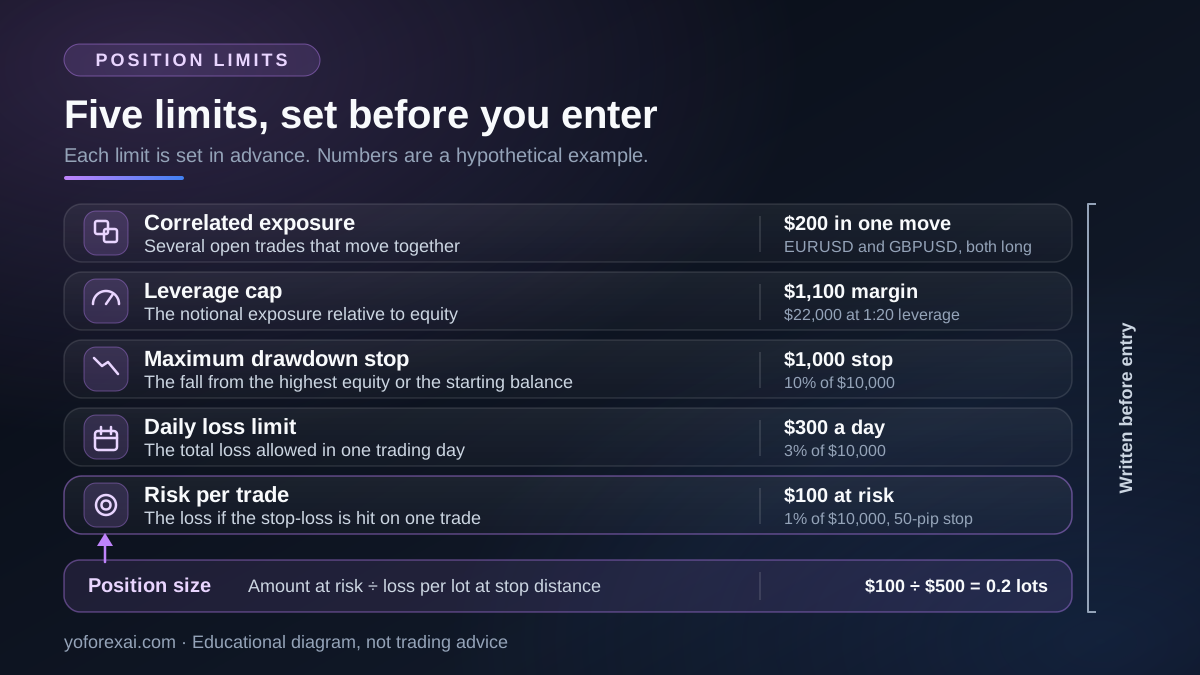
A written plan often uses five limits. Each one caps a different part of the account, so setting one does not set the others. Write the values in your trading plan, then test them on a demo account before you use them with real money.
| Limit | What it caps | How to set it before trading |
|---|---|---|
| Risk per trade | The loss if the stop-loss is hit on one trade | A fixed percentage of the current balance. Position size is calculated from the stop distance. |
| Daily loss limit | The total loss allowed in one trading day | A fixed percentage or currency amount. No new trades after it is reached. |
| Maximum drawdown stop | The fall from the highest equity or the starting balance | Pause and review the plan when it is reached, rather than changing size to recover. |
| Leverage cap | The notional exposure relative to equity | The highest leverage you will use, checked against the margin each order needs. |
| Correlated exposure | Several open trades that move together | A combined risk total across related pairs, for example EURUSD and GBPUSD both long. |
Position size links these limits together. For a chosen risk per trade and a chosen stop distance, the lot size is the amount you accept to lose divided by the loss per lot at that stop. The pip arithmetic is explained in our guide to forex pips. If you are still learning the basics, start with the beginner forex trading guide.
How do the limits work together? A hypothetical example
The numbers below are hypothetical. They use a $10,000 account, a 50-pip stop, and a position of 0.2 standard lots of EURUSD, where one standard lot is worth $10 per pip. The figures are round so that each step can be checked. They are not a suggested size and they do not reflect any broker's terms.
| Step | Calculation | Result |
|---|---|---|
| Risk per trade | 1% of $10,000 | $100 |
| Pip value of the position | 0.2 lots × $10 per pip per standard lot | $2 per pip |
| Loss if the 50-pip stop is hit | 50 pips × $2 | $100 |
| Daily loss limit | 3% of $10,000 | $300 |
| Losing trades that reach the daily limit | $300 ÷ $100 | 3 |
| Maximum drawdown stop | 10% of $10,000 | $1,000 |
| Notional value of the position | 20,000 EUR × 1.1000 | $22,000 |
| Margin at a 1:20 leverage cap | $22,000 ÷ 20 | $1,100 |
Three losing trades of this size use up the daily limit. Under the plan, the fourth trade of the day is not taken, even if its setup looks clear. The $1,000 drawdown stop is a point for review after several bad days, not a signal to increase size and win the money back.
The leverage row shows why the cap matters. At 1:20 the position needs $1,100 of margin, and the broker's own margin rules still apply. Margin mechanics, including how leverage sets the margin a position needs, are covered in our leverage and margin guide.
How do a daily loss limit and a drawdown stop differ?
A daily loss limit resets each day. It stops a poor session from becoming a poor week. A drawdown stop is measured from a peak or a starting balance and does not reset on its own. It asks a different question: is the approach still behaving the way it was tested to behave? Many written plans use both, because one guards against a bad day and the other guards against a long decline.
Decide in advance how each limit ends trading. A daily limit usually means no new trades until the next session. A drawdown stop usually means a pause for review, with written conditions for resuming. Changing the limit during a losing period defeats the purpose of setting it.
Do leverage and loss rules differ by country?
Leverage caps and close-out rules are set by regulators, and they differ by country and by client type. The 2018 EU rule for retail CFDs is covered in our leverage and margin guide. Two more examples show the range.
The UK Financial Conduct Authority (FCA) confirmed permanent restrictions on the sale of CFDs to retail consumers in 2019. Its rules limit leverage to between 30:1 and 2:1, require firms to close out positions when funds fall to 50% of the margin needed, and guarantee that a client cannot lose more than the total funds in the CFD account. Source: FCA, FCA confirms permanent restrictions on the sale of CFDs and CFD-like options to retail consumers.
In the United States, the Commodity Futures Trading Commission (CFTC) states that leverage in retail forex customer accounts is subject to a security deposit requirement. The National Futures Association sets that deposit within limits provided by the Commission. Source: CFTC, Foreign Currency Trading.
Your own regulator and your broker's published terms decide the rules that apply to your account. Rules change, so check the current text rather than relying on a summary, including this one. In some countries certain products are not available to retail clients at all.
What can risk control not tell you?
Risk control limits the damage from losing trades. It does not tell you whether a trade will win, and no limit can guarantee a profit, a win rate, or a particular result over a month. Four points are worth keeping in mind:
- A stop-loss order is not a guaranteed exit price. Prices can gap over a weekend or around news, and spreads can widen, so a loss can be larger than planned.
- A percentage limit is only as accurate as the balance behind it. After a large loss, the same percentage gives a smaller amount, which is intended, but the plan should be reviewed when that happens.
- A backtest or a demo result does not show that the limits will hold in a live market. Testing has its own limits, which are covered in our guide to evaluating a forex EA.
- Limits do not depend on any tool. A chart analysis, an Expert Advisor or a signal service does not replace a written plan, and none of them can decide your risk for you.
To practise limits without money at risk, the paper trading guide explains what that kind of practice does and does not show.
Key takeaways
- Set risk limits before you enter a trade, and write them down.
- Position size comes from the loss you accept and the stop distance, not from the leverage a broker offers.
- A daily loss limit and a drawdown stop answer different questions. Each needs a rule for when trading stops.
- Trades that move together count as one larger exposure.
- Regulators set leverage and close-out rules that differ by country. Check the rule that applies to you.
- Limits control losses. They do not make a strategy profitable.
Risk disclosure
Forex trading with leverage can lose money quickly. You can lose more than you deposit, depending on your broker and country, so read the negative balance protection terms before you trade. The examples on this page are hypothetical. They show the arithmetic only. They are not forecasts, and they do not imply any outcome.
Frequently asked questions
What is a good risk per trade in forex?
There is no universal figure. Many written plans cap risk per trade at a small percentage of the balance, but the right number depends on your balance, your strategy's results, and how many losing trades you can absorb without changing the plan. Test the limit on a demo account before you use it live.
Is a stop-loss enough risk control?
No. A stop-loss limits the loss on one trade, and only if it fills near its price. It does not limit the daily loss, the drawdown, or the exposure across correlated trades. Each of those needs its own limit.
How is position size calculated from a stop-loss?
Divide the amount you accept to lose by the loss per lot at your stop distance. With $100 at risk and a 50-pip stop on EURUSD, one standard lot loses $500 over 50 pips at $10 per pip. The size is therefore 0.2 lots. The figures are a worked example, not a recommendation.
Does a daily loss limit stop losses from gaps?
Not always. A daily limit can only be reached after losses have happened, and a gap can produce a loss larger than the stop distance. The limit controls what you do next. It does not control the size of the first loss.
Should a daily loss limit change after a winning day?
Not on its own. The limit is written into the plan, so a winning day does not move it. A change to the limit is a change to the plan. It should be made in advance and reviewed, not during a session after a run of gains, when the same urge to increase size that causes losses can also decide the new number.
Sources and verification
Primary-source links used for the platform behavior and risk statements in this guide. Sources reviewed 9 November 2026.
- U.S. Commodity Futures Trading Commission: Foreign Currency Trading · Reviewed
- UK Financial Conduct Authority: FCA confirms permanent restrictions on the sale of CFDs and CFD-like options to retail consumers · Reviewed