YoForex AI educational guides
What is pips in forex trading? Pip size, pip value and pipettes
A pip is the smallest standard price step in a currency pair quote: usually the fourth decimal place, or the second for yen pairs. Traders use pips to measure price distance. Pip value converts that distance into money, based on position size and the quote currency. Check your broker's symbol specification before you size a trade.
Published · Updated · By YoForex AI Editorial Team
What is pips in forex trading?
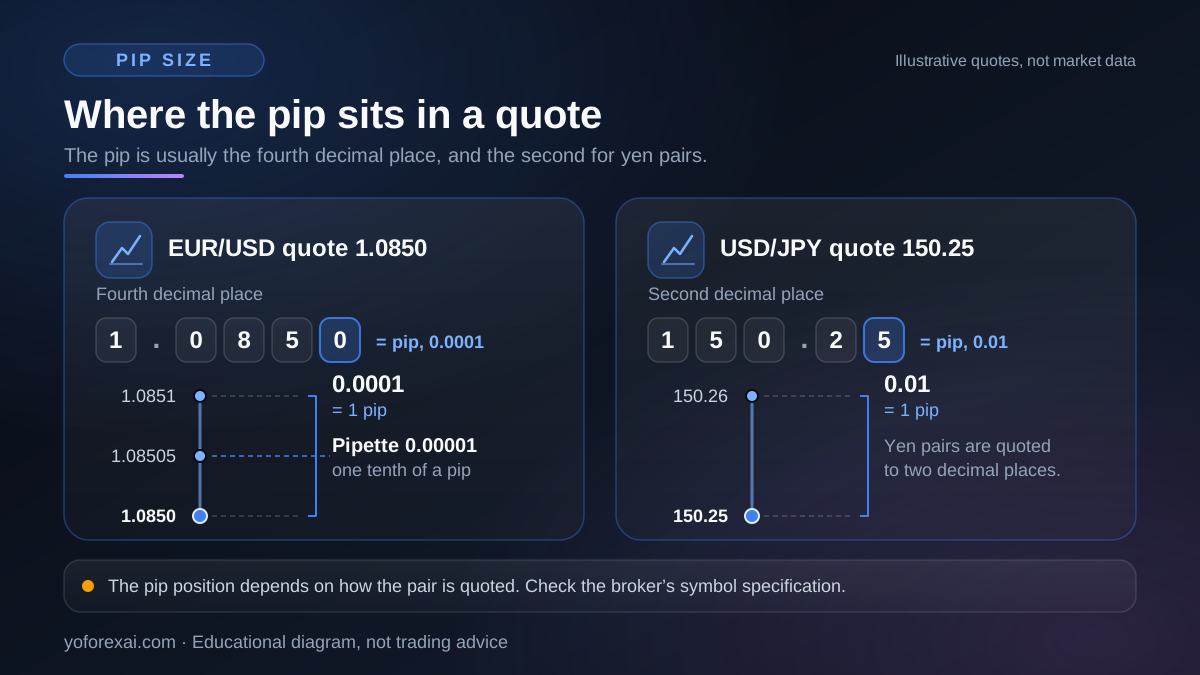
A pip is the smallest standard unit of price movement that a currency pair quote shows. The CFTC futures glossary defines a pip as the smallest price unit of a commodity or currency. Most pairs are quoted to four decimal places, so one pip is a one-step change in the fourth decimal. For EUR/USD, a move from 1.0850 to 1.0851 is one pip. Traders use pips because they are shorter to say than a full decimal price, and because stop-loss and take-profit levels are often written as a distance from entry.
Pips measure distance, not money. A move of 20 pips does not mean anything to your account until you know the pair, the position size and the account currency. The same 20-pip move can be a small result on a small position and a large loss on a large one. New to the market? The how to start forex trading guide covers the basics before you work with pip values.
How big is a pip for each type of pair?
The pip sits in a fixed decimal position, but that position depends on how the instrument is quoted. The table covers the four cases you are most likely to meet. Each broker publishes its own symbol specification, and that document is the final reference for any instrument you trade.
| Quote type | Example quote | Where the pip sits | Pip size |
|---|---|---|---|
| Most currency pairs | 1.0850 (EUR/USD) | Fourth decimal place | 0.0001 |
| Yen pairs | 150.25 (USD/JPY) | Second decimal place | 0.01 |
| Metals and indices | Varies by symbol, for example XAUUSD | Set by the broker's symbol specification | No single rule; check the specification |
| Pipette (fractional pip) | 1.08505 (EUR/USD) | Fifth decimal place on four-decimal pairs | 0.00001, one tenth of a pip |
Yen pairs are quoted to two decimal places, so their pip is 0.01 rather than 0.0001. The arithmetic is the same, but the number you read is different. Do not carry the forex rule over to gold, silver or an index. Read the tick size and the contract size in the broker's specification before you use the word pip with a metal or index.
How do you work out pip value?
Pip value is the money change for one pip of price movement on a given position. For a pair where US dollars are the quote currency, such as EUR/USD, the calculation is the position size, measured in units of the base currency, multiplied by the pip size. The example below is hypothetical and uses round numbers.
Hypothetical example: suppose you hold 100,000 units of EUR/USD and the pip size is 0.0001. Each pip moves the position by 100,000 multiplied by 0.0001, which is 10 US dollars. A 25-pip move is then worth $250 before costs. The table shows the same calculation for smaller positions.
| Position size (EUR) | Pip value (USD) | A 25-pip move (USD) | Note |
|---|---|---|---|
| 10,000 units | $1.00 | $25.00 | Hypothetical; before spread and commission |
| 50,000 units | $5.00 | $125.00 | Hypothetical; before spread and commission |
| 100,000 units | $10.00 | $250.00 | Hypothetical; before spread and commission |
When the quote currency is not US dollars, the pip value is first in that currency and must be converted to your account currency. Here is a second hypothetical example. You hold 100,000 US dollars of USD/JPY, and the pip size is 0.01. Each pip is worth 1,000 yen. At an assumed rate of 150 yen per dollar, that is about $6.67 per pip. Check the live rate with your broker, because it changes.
What are pipettes and fractional pips?
Some brokers quote one more decimal place than the pip itself. Your platform or broker may call that extra digit a pipette or a fractional pip, so check the symbol specification for the exact digit count. On a four-decimal pair, a pipette is 0.00001, which is one tenth of a pip. The finer price shows more detail in the quote, but it does not change what a pip is. When you read a stop or a target written in pips, check whether the number is a whole pip or a fraction of one.
How do pips differ from points in MetaTrader 5?
MetaTrader 5 describes each symbol with properties such as the point value and the number of digits. The MQL5 reference on symbol properties describes SYMBOL_POINT as the symbol point value, and SYMBOL_DIGITS as the number of digits after the decimal point. Read both properties for each symbol you trade. The pip is a trader convention that sits on top of them, and the number of points in one pip depends on the symbol's digits and point value, which are set per symbol in your platform. Read the symbol properties in your own platform, rather than assuming the forex rule.
How do pips fit into stop-loss and risk planning?
A stop-loss written as 20 pips is a distance. To find the money at risk, multiply the number of pips by the pip value for your position size. Using the hypothetical 100,000-unit EUR/USD position above, a 20-pip stop is a loss of about $200 before spread, commission and slippage. Size the position so that loss matches the amount you have decided to risk on one trade. The forex risk control guide explains how to set that limit, and the leverage and margin guide explains how a larger position can tie up more of your account.
Risk warning. You can lose more than you deposit, depending on your broker and country. The CFTC's customer advisory on forex states that high leverage amplifies both gains and losses, and that a trader may be liable for losses beyond the initial deposit. A stop-loss is not a guarantee. In a fast market, it can fill at a worse price than the level you set.
What can pips not tell you?
A pip count measures distance. It does not tell you how likely price is to reach a level, how long a move will take, or whether a setup is worth taking. Three limits matter most.
- Pips do not compare across instruments. A 20-pip move in one pair is not the same risk as a 20-pip move in another, because pip value depends on the quote currency and the position size.
- Pips do not include costs. Spread, commission and overnight financing all reduce what a pip move is worth to you. Check your broker's conditions before you rely on a pip target.
- Pips do not describe volatility. Twenty pips can be a large move in a quiet session and a small one around a news release. Compare a pip distance with the recent price range before you judge it.
Tools and expert advisors may also print pip distances. Those numbers come from their rules or their levels, so check how the figure was counted before you accept it. The forex EA evaluation guide explains how to test a rule-based system, and the paper trading guide explains how to test pip-based rules without real money.
Key takeaways
- A pip is the smallest standard price step in a quote: usually the fourth decimal place, or the second for yen pairs.
- Pips measure distance. Pip value turns that distance into money, based on position size and the quote currency.
- A pipette is a fraction of a pip, shown by brokers that quote an extra decimal digit.
- Metals and indices do not follow one pip rule. Read the broker's symbol specification.
- To find the money at risk on a stop, multiply the pips by the pip value, then size the position to match your limit.
Frequently asked questions
What is a pip in forex in simple terms?
A pip is the smallest standard price step for a currency pair. For most pairs it is 0.0001, the fourth decimal place. For yen pairs it is 0.01, the second decimal place. It is a unit of price distance, not a unit of money.
How much is one pip worth?
It depends on the position size and the pair. In the hypothetical EUR/USD example above, one pip is worth $10 on a 100,000-unit position. The same pip move on a 10,000-unit position is worth $1. Check the pip value in your own account currency before you size a trade.
Is a pip the same as a point?
Not always. In MetaTrader 5, a point is the symbol point value, SYMBOL_POINT, and the number of points in one pip depends on the symbol's digits and point value, which are set per symbol in your platform. The MQL5 symbol properties give the point value and digits for each symbol in your platform.
Does a 20-pip gain mean a profitable trade?
No. A pip count does not include spread, commission, swap or the position size. A 20-pip gain on a small position can be less than the costs of the trade. Work out the money result from pip value and the full set of costs.
How do I test a pip-based strategy?
Write the rules, including the pip distances, before you test. Then run them on a demo or paper record and compare the results with the rules rather than with your memory of the best trades. The forex EA evaluation guide describes a structured approach to this.
Sources and verification
Primary-source links used for the platform behavior and risk statements in this guide. Sources reviewed 9 November 2026.
- U.S. Commodity Futures Trading Commission: Futures Glossary · Reviewed
- U.S. Commodity Futures Trading Commission: Customer Advisory: Eight Things You Should Know Before Trading Forex · Reviewed
- MetaQuotes: Symbol Properties · Reviewed