YoForex AI educational guides
Cup handle pattern: rules, failure signals and forex use
A cup handle pattern is a rounded, U-shaped base called the cup, followed by a smaller pullback called the handle near the cup's upper edge. Traders treat a close above the handle as the breakout signal. The rules here are written for forex charts, which trade around the clock and have no central volume feed.
Published · Updated · By YoForex AI Editorial Team
What is a cup handle pattern?
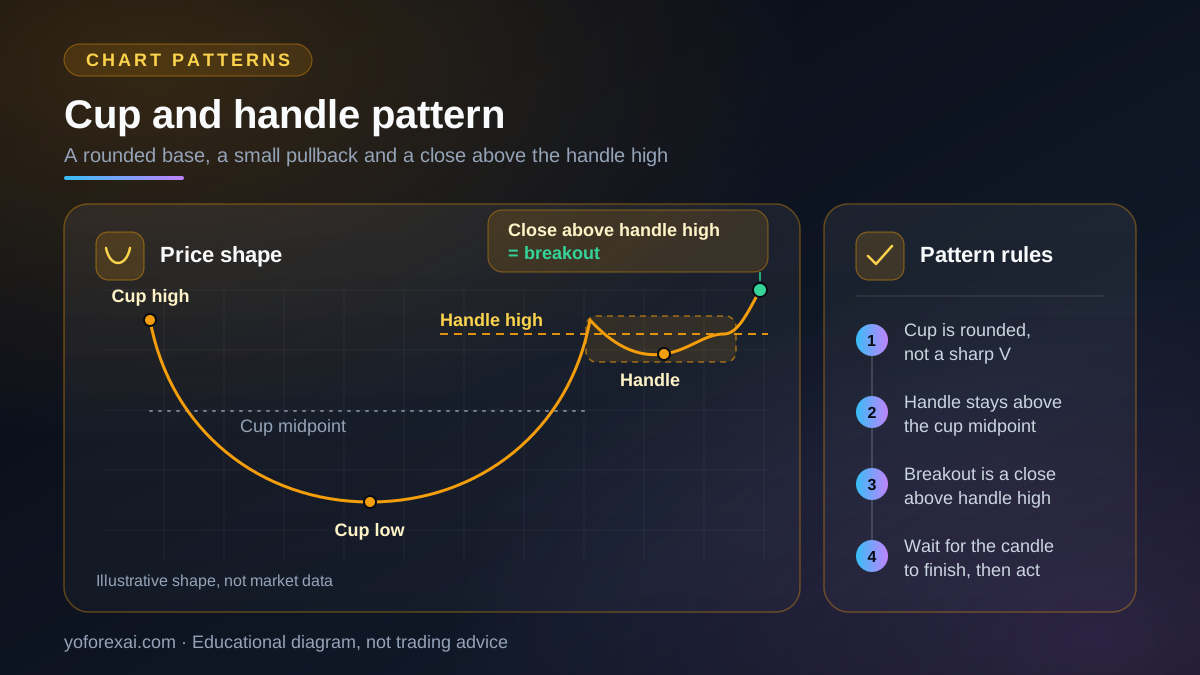
The cup handle pattern, also written cup and handle pattern, is a chart shape with two parts. The cup is a rounded decline and recovery that forms a U-shaped base. The handle is a smaller pullback that forms in the upper part of the cup, after price has climbed back toward the cup's high. This guide treats the shape as a continuation pattern, a pause inside an existing rise.
The outline can appear on any price chart, but the rules on this page are written for currency pairs. The section on gaps and timeframes below explains where forex charts need different handling. For the wider set of shapes, read the trading chart patterns guide, which compares this pattern with others. Triangles use converging lines rather than a rounded base, and the triangle chart patterns guide covers them separately. This page covers only the cup and handle.
How does a cup and handle form?
The cup begins at a high. Price falls, slows near a low, and then rises back toward the starting high. The bottom should look rounded on your chart, not like a sharp V. A quick drop and an equally quick recovery produce a different shape, and labelling it a cup usually means the rules are being bent after the fact.
The handle forms after the recovery. Price pulls back, normally by less than the decline inside the cup, and tends to drift sideways or down before the breakout. The handle is the part of the pattern that most traders find hardest to define, because it can look like ordinary noise on a small timeframe.
Hypothetical example. A pair peaks at 1.1000, falls to 1.0850, and climbs back to 1.0995. A small pullback then holds between 1.0960 and 1.0990. The handle high is 1.0990, so a close above that level is the breakout close this rule would test. The numbers are round and made up for illustration only.
What rules define a valid cup and handle?
A rule set turns a shape into a test. Any set of rules is a choice, and the numbers below are one common way to write them. Use your own values, but fix them before you look at the chart.
- The cup is rounded. The bottom should take time to form. A sharp V is a different pattern, and it should not be counted as a cup.
- The cup depth has a limit. Measure the decline from the cup high to the cup low on one timeframe. Write down the maximum depth you accept. A cup that is deeper than your limit is not a setup, even if the rest of the shape looks tidy.
- The handle stays in the upper part of the cup. The pullback should stay above the midpoint of the cup under your rule. A pullback that falls below the midpoint changes the pattern into a different one.
- The handle is shallower than the cup decline. A handle that retraces most of the cup has little left to break out from, so this guide treats it as weak.
- The breakout is a close above the handle high. A spike through the level that closes back inside the handle does not count under this rule.
- Any target is a method, not a result. Some traders project the cup depth upward from the breakout. Treat that projection as a rule to test on past charts, not as a price that will be reached.
How do you confirm the breakout?
Confirm the breakout with the same timeframe and the same candle rule each time. A close beyond the handle high is the usual condition. Wait for the candle to finish. If you act on the intrabar move, you may be acting on a level that the candle later closes back under.
- Mark the handle high and the handle low on the timeframe your rule uses.
- Place the protective stop on the other side of the handle, not at a distance chosen by feel.
- Check whether the cup rim sits inside a wider zone. The support and resistance guide explains how to mark levels as zones rather than single prices.
- Check the higher-timeframe trend. A cup that forms inside a longer decline has less support for a rise.
Which failure signals should you watch for?
A failure signal is the observation that tells you the setup did not behave as your rules expected. Write these down before you trade, so that you do not have to decide during a fast move.
| Failure signal | What you would see | Rule response |
|---|---|---|
| The base is a sharp V | A fast drop and an equally fast recovery with no rounded bottom. | Do not count it as a cup. Label it as a different pattern, or leave it unlabelled. |
| The handle breaks the cup midpoint | The pullback falls below the halfway level of the cup. | The setup fails your handle rule. No breakout trade. |
| A false breakout | Price trades above the handle high, then a candle closes back inside the handle. | The breakout is not confirmed. Wait for a new close or skip the setup. |
| Breakout fails after entry | Price returns below the handle low after you entered. | The invalidation point is hit. Exit according to the plan you wrote before entry. |
How do weekend and news gaps change a cup or handle?
A gap is a jump between one candle's close and the next candle's open. On forex charts, gaps usually come from the weekend pause or from a news release. A gap changes where you can draw the cup rim and the handle high, so decide the rule for gaps before you draw anything.
- The cup rim across a weekend gap. If the left rim sits just before a weekend gap, choose one reference for every cup you test: the last close, or the highest wick. Record the choice with each observation, so that a rim is not moved after the outcome is known.
- A gap above the handle high. An opening gap above the handle high is not a breakout by itself. Under the close rule on this page, a candle must close above the handle high. Note whether the closing candle opened in a gap, because that breakout is harder to act on.
- A gap through the cup bottom. A gap can make a rounded base look like a V. Check the base with the gap included and with it removed, and count the cup only if the rounded shape holds under your rule.
- Which timeframe to read the handle on. Read the handle on the same timeframe as the breakout close, so the handle high and low are the levels your rule checks. A lower timeframe can show the handle more clearly, but a handle that appears only there describes a smaller pattern, not the same one.
- Reading volume on the handle. The MetaQuotes Volumes help page says: “For the Forex market, Volumes is the indicator of the number of price changes within each period of a selected timeframe.” A quiet handle may simply be a quiet period, so do not treat low volume as confirmation on its own.
For the general differences between forex and stock charts, including trading hours and how forex volume is shown, see the trading chart patterns guide.
What the cup and handle cannot tell you
The pattern does not forecast how far price will travel or how long a move will take. A breakout does not show that buyers are in control, and a failed breakout does not show that sellers are. The shape is drawn by hand, so two readers can place the cup rim or the handle low in different spots and still both feel they are right.
The UK Financial Conduct Authority warns that the timeframe or data shown on a price graph may be selected to support a particular viewpoint. A cup that looks clean on a published chart may have been chosen after the breakout, so test the rules on charts you mark yourself. The trading chart patterns guide covers this limit for patterns in general.
Testing matters more than the shape. Write the rules, record every cup that meets the depth and handle conditions, including the ones you did not trade, and compare the results with the rules. A paper trading record can check whether you apply the rules consistently. It cannot show real fills, spreads or the stress of a live position. Setups on longer timeframes, such as those covered in the swing trading guide, need more time to test and often produce fewer examples.
Risk warning. You can lose more than you deposit, depending on your broker and country. Leverage can magnify losses quickly. A cup and handle that looks clean on past charts can still fail, and a confirmed breakout can reverse within a few candles. Check the rules that apply to you with your own regulator or local authority before you trade any setup.
Key takeaways
- A cup and handle is a rounded base followed by a smaller pullback in the upper part of the cup. It is usually read as a continuation shape.
- Write the cup depth limit, the handle rule and the breakout close before you look for the pattern.
- Confirm the breakout with a close above the handle high on your chosen timeframe, not with a spike.
- Forex has no central exchange volume, trades around the clock, and can gap around the weekend and news. Adjust the rules for those facts.
- Test the rules forward and accept poor results. The shape does not forecast size or timing.
Frequently asked questions
Is the cup and handle pattern bullish?
This guide reads it as a continuation shape when it forms inside an existing rise, and the breakout direction still decides the reading. The breakout direction still decides the reading. A cup that breaks down is a failed setup under most rule sets, and it does not become a bullish signal by default.
How long does a cup and handle take to form?
There is no fixed length. The time it takes depends on the timeframe you chose, the depth of the cup and the market conditions. Record the start and end candles, and avoid rules that depend on a set number of days.
Does the cup and handle work in forex?
The shape appears on forex charts, but the claim that it works is an empirical question. Test your rules on past charts you did not use to write them, then forward test them with a demo or paper record. Do not rely on a published win rate, because in this guide's view many published results do not state the market, timeframe or sample size.
How is a cup and handle different from a rounding bottom?
A rounding bottom is a rounded base on its own. The handle is the extra pullback that defines the cup and handle shape. If your chart has a rounded base but no handle that meets your rule, you are looking at a different setup, and your rules should say so.
Can AI find cup and handle patterns for me?
An AI model can describe a shape you show it, but its cup rim, handle high and timeframe need checking against the chart. Ask it to list the candles it used, then confirm them yourself. The AI forex chart analysis guide has a checklist for that step.
Sources and verification
Primary-source links used for the platform behavior and risk statements in this guide. Sources reviewed 9 November 2026.
- UK Financial Conduct Authority: Understanding price graphs · Reviewed
- MetaQuotes: Volumes · Reviewed