YoForex AI educational guides
What is swing trading? Holding periods, swap costs and forex basics
Swing trading means holding a position for more than one trading day, typically days to weeks. It sits between day trading, which closes within the same session, and position trading, which holds for months. In forex, holding time comes from your rules, and positions held past the daily rollover can incur a swap charge or credit.
Published · Updated · By YoForex AI Editorial Team
What is swing trading? A plain definition
Swing trading means holding a position across one or more daily closes. A swing trader opens a position, keeps it open across one or more daily closes, and exits when a planned condition is met. The holding period is the central idea. The entry rule, the exit rule and the risk limit are separate decisions, and each one needs its own definition before a trade is placed.
The word “swing” describes the time the trade takes, not a particular indicator or chart pattern. A swing trader can find an idea with moving averages, support and resistance levels, or an AI chart read. Each of those tools is separate from the holding period. Many swing traders read charts on a higher timeframe, such as the daily or the 4-hour chart, and review open positions at set times rather than every few minutes.
If you are new to holding positions across days, start with our beginner forex trading guide. It explains the basic order terms and risk settings that apply to any holding period.
How do holding periods compare?
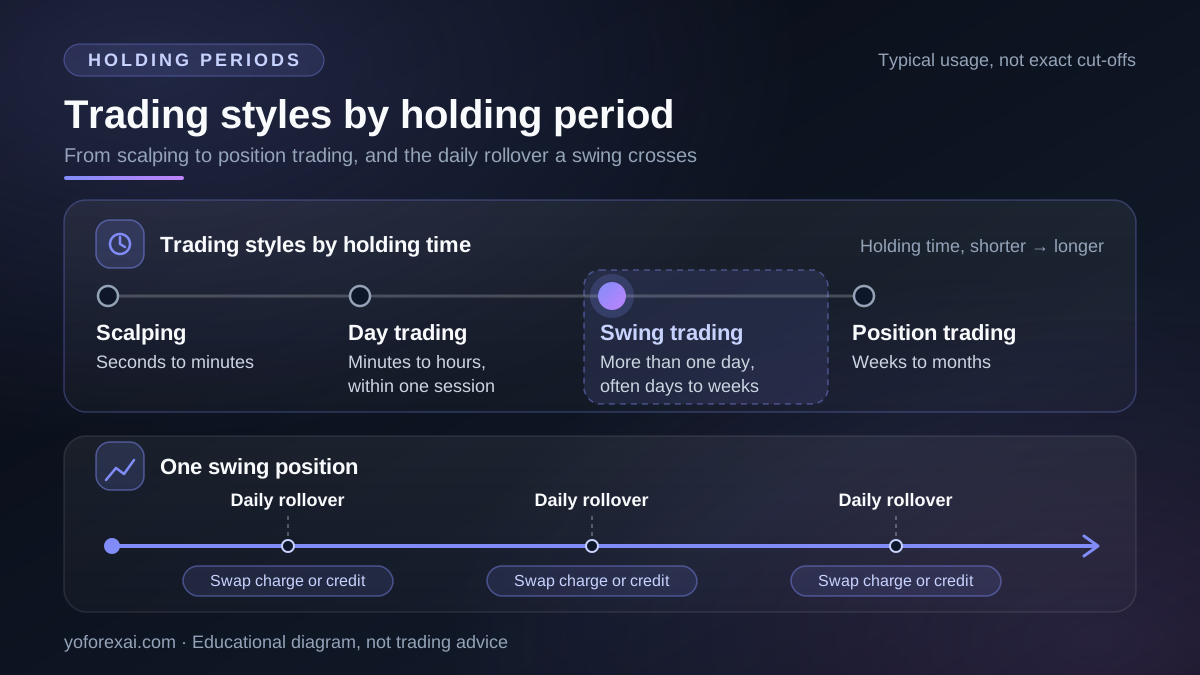
Trading styles are often grouped by how long a position stays open. The table below is a general guide. Traders and brokers do not agree on exact cut-offs, so read the ranges as typical usage rather than as definitions.
| Style | Typical holding time | Overnight exposure |
|---|---|---|
| Scalping | Seconds to minutes | Usually none |
| Day trading | Minutes to hours, within one session | Usually none, by design |
| Swing trading | More than one day, often days to weeks | Yes, by design |
| Position trading | Weeks to months | Yes, by design |
The table describes the trader's intended horizon. It does not describe what a trade actually did. A position that was planned as a swing can close within the first session, and a day-style plan can be left open by mistake. The record of open and close times is the only way to check the actual holding period.
Swing trading vs day trading: what changes?
The useful comparison is not which style is better. It is what each style asks of you. A day trader manages positions within one session and must act on intraday moves. A swing trader accepts that a position will pass through several sessions, and that the account will carry the result of each night. Three practical differences matter most.
- Overnight exposure. A swing position stays open past the daily close. It can be affected by news released while the market is open, and by a price gap when trading resumes.
- Costs. Both styles pay the trading costs your broker charges. A swing trade also carries swap, the charge or credit for holding a position past the daily rollover, which is set in each symbol's specification.
- Attention. Day trading needs time at the screen during the session. Swing trading needs fewer checks, but more planning for what the position does while you are away.
Neither style is safer by default. Each carries its own costs and its own failure modes. Choose the style that matches the time you can give to the trade and the losses you can absorb while you are not watching.
Does an EA's holding time come from its rules?
Yes. An Expert Advisor does not have a trading-style label. Its holding time is a result of its entry and exit code, its stop-loss and take-profit settings, and any time filters it uses. An EA that closes every position before the session ends behaves like a day-style system, whatever the vendor calls it. An EA that keeps trades open across several sessions is holding overnight, and its results depend on overnight costs.
Check the rules and the trade history, not the name. In a test report, look at the average holding time and at how many trades cross the daily rollover. Our MT5 Expert Advisors page explains the platform side. For a method to test an EA, read our guide to evaluating a forex EA.
What does holding a position overnight cost?
In MetaTrader 5, a position that is still open at the daily rollover is carried into the next day, and the symbol's swap values set the charge or the credit. The MQL5 reference describes the day-of-week swap property as “The day of week to charge 3-day swap rollover.” The symbol properties also include separate long and short swap values. A long and a short position on the same pair may therefore cost different amounts, and one direction may earn a credit.
The rollover time and the swap figures come from your broker's symbol specification, and they can change. Check them before you hold a position overnight, not after the first charge appears. Source: MQL5 documentation, market information constants.
How do you plan a swing trade before you enter?
- Name the timeframe you read and the timeframe you use to time the entry.
- Write the entry, stop-loss and exit rules in plain words, so another person could follow them.
- Decide the maximum loss you accept, in your account currency, before you open the position.
- Check the swap for the direction you plan to hold, and the rollover time, in the symbol specification.
- List scheduled events, such as central bank decisions, that fall inside the planned holding period, and decide in advance what you will do about them.
- Set how many sessions you will allow before the idea is reviewed, and the conditions that end it early.
Position size matters for a held trade because the margin stays tied up while the position is open. Our guide to forex leverage and margin shows how position size, stop distance and required margin fit together. Practice the routine on a demo account first, using the approach in our paper trading guide.
What swing trading cannot tell you
A holding period is not a signal. Knowing that a trade will be held for several days does not tell you which way price will move. The term describes time, and it does not make a method profitable. A swing approach can lose on many trades, and holding for longer does not reduce the loss on each unit of risk.
Prices can open away from the previous close, especially after weekends and around major releases. A stop order can fill at a worse price than the level you set. Backtests and past charts show how a rule behaved on past data, and they do not show how the same rule will behave when it is held through the next session.
You can lose more than you deposit, depending on your broker and country. Overnight holds add swap costs and gap exposure that a day trade may avoid. In 2018 ESMA set measures for retail CFD trading in the EU, including negative balance protection on a per account basis. That is one regulator's rule for one region, and it does not cover every product or broker. Check the rules that apply to you with your national regulator and your broker's terms. Source: ESMA, ESMA adopts final product intervention measures on CFDs and binary options.
Key takeaways
- Swing trading means holding a position across more than one trading day, typically days to weeks.
- The holding period is a choice about time. It does not set a direction or prove a method.
- In forex, a position held past the daily rollover carries a swap charge or credit set by the symbol specification.
- An EA's holding time comes from its code, so check its trade history for overnight holds.
- Overnight holds add gap and news exposure. Check your country's rules and your broker's terms.
Frequently asked questions
What is swing trading in simple terms?
It is holding a position for more than one trading day, usually to capture part of a larger move. The trader accepts that the position will stay open overnight and will be affected by what happens while the market is closed or moving on news.
Is swing trading better than day trading?
Neither is better in general. Each style asks for a different time commitment, cost profile and kind of risk. Your schedule and your tolerance for overnight exposure are the practical deciding factors.
How long is a swing trade?
Typically more than one day, often days to weeks. Traders do not agree on an exact cut-off. The holding time that matters is the one your plan sets, and the one your trade history shows.
Do swing trades pay swap?
Only when a position stays open past the daily rollover. Whether it is a charge or a credit depends on the symbol's long or short swap values and the direction of the trade. Check the broker's symbol specification for the pair you plan to hold.
Can an Expert Advisor do swing trading?
Yes, if its rules keep positions open across sessions. Read its documented entry and exit logic, and check its trade history for overnight holds, before assuming any holding period.
Sources and verification
Primary-source links used for the platform behavior and risk statements in this guide. Sources reviewed 9 November 2026.
- European Securities and Markets Authority: ESMA adopts final product intervention measures on CFDs and binary options · Reviewed
- MetaQuotes: Symbol Properties · Reviewed