YoForex AI educational guides
Telegram forex signals: a checklist before you join
Telegram forex signals are trade ideas or alerts posted in a Telegram chat, group or channel. No signal provider can guarantee results. Before you act on one, check who is behind it, whether a regulator in your country authorizes them, how results are shown, and whether you can test the alerts on a demo account first.
Published · Updated · By YoForex AI Editorial Team
What are Telegram forex signals?
Telegram forex signals usually means a stream of messages that suggest a currency pair, a direction, an entry price or area, a stop level and a target. The messages arrive in a Telegram channel, a group or a private chat, and sometimes come from an automated bot. Some are free. Many are sold on a subscription, and some free channels exist mainly to sell a paid upgrade.
A signal rarely shows the reasoning behind it, the risk taken on each idea, the account it came from, or the trades that were not posted. You receive a conclusion without the evidence needed to judge it. You still have to decide whether to act, choose the size, place the order and manage the exit. Losses are real even when a message looks precise, timely and confident.
Which red flags matter most in a Telegram signal offer?
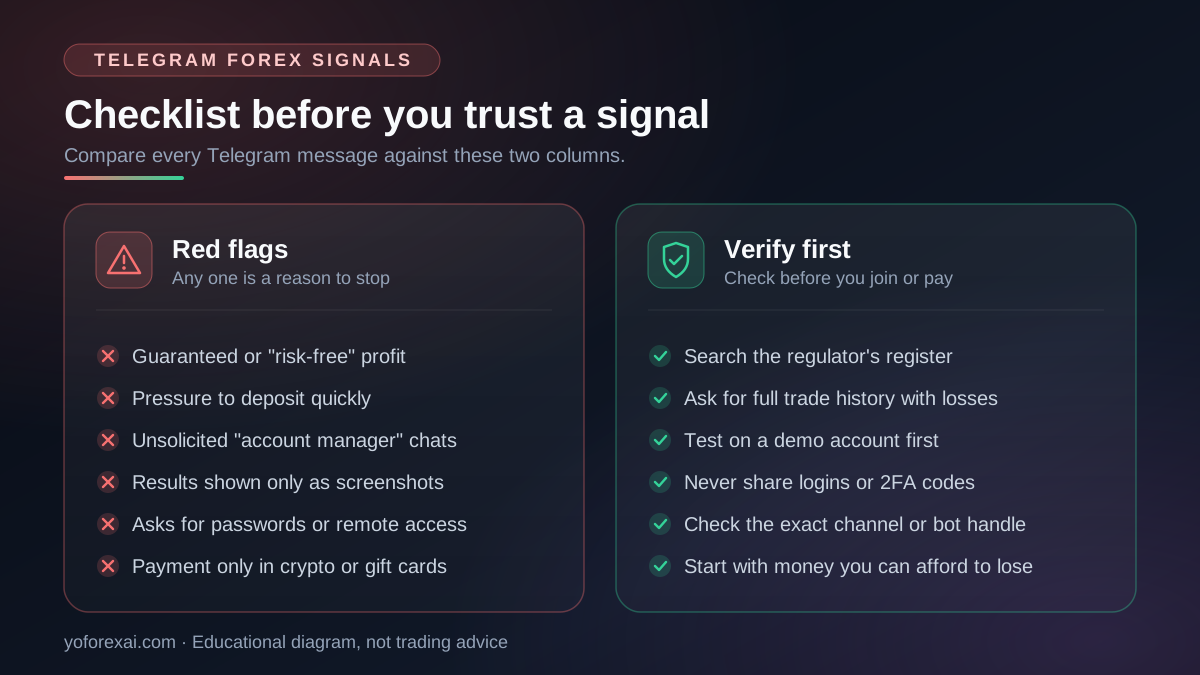
Most problems with signal sellers show up before any trade is posted. Look for these warning signs first. Any one of them is a reason to stop and check further. Several together are a reason not to continue.
- Guaranteed or “risk-free” profit. No provider can promise a trading result. A promise of certainty is a claim to refuse, not a feature to compare.
- Pressure to deposit quickly. Countdowns, “last places” and bonuses tied to a fast deposit leave you no time to check anything.
- Unsolicited “account manager” or “recovery” messages. If someone contacted you first and offers to manage or recover money, assume the contact is the sales method.
- Results shown only as screenshots. An image can be edited or selected. A statement you can download from your own broker is a different kind of evidence.
- Requests for passwords, codes or remote access. A legitimate signal service has no reason to ask for your broker password, a one-time code or control of your computer.
- Payment only in cryptocurrency, gift cards or to a personal account. Hard-to-trace payment methods are a common feature of scams.
- A self-reported win rate with no period, account or method. A percentage alone tells you nothing. Do not treat any quoted win rate as proof, whatever its size.
How do you verify a signal provider before you join?
Start with identity. Check the exact channel name, the bot handle and any website address, character by character. Scam channels often copy the name of a legitimate one with a small change. Then ask the provider which legal entity runs the service, which country it is based in, and which regulator, if any, authorizes that entity to give investment advice or to manage money.
Next, ask for a complete record rather than a highlight reel. A useful record names the account, the period, the instruments, the risk on each idea and every losing trade. It should also show costs such as spread, commission and financing. If the answer is a list of screenshots and testimonials, you have not learned how the service performs.
| Claim | Evidence that would support it | Red flag |
|---|---|---|
| “We win most of our signals” | Complete trade history for a named account, with the period, instruments, risk per idea and every losing trade. | A percentage with no period, account or method. |
| “Guaranteed monthly income” | Nothing a provider can supply. No evidence can make a guarantee credible. | Any guarantee of profit or income. |
| “Regulated” or “licensed” | An entry you find yourself on your regulator’s public register, matching the firm name and reference number. | A logo, certificate or badge with no register entry. |
| “Results verified” | A statement you can download from your own broker or an independent administrator. | Screenshots or spreadsheets the provider controls. |
| “Risk is controlled” | Written stop rules, a maximum risk per idea and an explanation of what happens in a price gap. | Only “low risk” or no written rules. |
How do you check a firm with a regulator?
Registration rules differ by country. Check your own national regulator first. The examples below show public lookups in several places. They are not a complete list, and a listing on one register does not carry over to another country.
- United Kingdom. The Financial Conduct Authority publishes a Firm Checker for authorized firms and a Warning List of firms and individuals running scams or operating without authorization. The FCA advises typing its address yourself, then matching the firm reference number and contact details against the Firm Checker. If the details do not match, use the contact details on the Firm Checker, not the ones the firm gives you (FCA, “Protect yourself from scams”).
- European Union and EEA. ESMA advises checking that a trading platform appears in its register and confirming authorization with your domestic national competent authority. ESMA also warns that a missing entry on the IOSCO Investor Alerts Portal does not confirm that a firm is authorized or legitimate (ESMA, Investor Corner).
- United States. The National Futures Association runs BASIC, a free search for the background of derivatives industry professionals (NFA, BASIC). Use BASIC only for derivatives industry professionals, and your own regulator’s register for any other license type.
- Elsewhere. Most countries run a public register or a warning list. Search for your national financial regulator and its consumer warning page before you search for the provider. Use the official address you find that way, not a link from a Telegram message.
A registration is a minimum check, not an endorsement. A registered firm can still publish poor advice, and an unregistered provider can still be honest about its limits. The register answers whether a firm is authorized. It does not answer whether its signals will make money.
How do Telegram signals differ from an Expert Advisor?
A signal is a message. If you act on it by hand, your broker account, your sizing and your exit decide the outcome. An Expert Advisor is software that runs rules inside a trading terminal, so its settings, permissions and the account it runs on matter. Either can lose money, and neither removes the need to understand the risk. The forex signals versus Expert Advisors comparison sets out the workflow differences in more detail.
How should you test a signal before you risk money?
- Write down each signal with the time you received it, before you check the price. Screenshot the message and the time if you can.
- Apply the same entry, stop and exit rules on a demo account, and record the result as if the trade were real.
- Record every signal, including those you would have skipped and those that lost. A log that only contains winners is not a test.
- Include costs. Spread, commission, swap and slippage can change a result that looks good on a chart.
- Review the log over a period that includes different market conditions, then decide in writing whether anything has earned real money.
Demo accounts simplify fills and emotional pressure, so a demo result overstates what live trading would have produced. The guide to paper trading explains those limits. Use the demo record to decide whether the signals are worth further study, not as proof that they are profitable.
Where do YoForex AI alerts fit?
This checklist does not recommend any Telegram group, channel or bot, and it does not rank providers. YoForex AI is our product. It sells AI forex analysis, and its alerts can be delivered through the YoForex AI dashboard, Telegram or WhatsApp. An alert is information, not an order, and it does not place trades. Read how the alerts work on the forex signals Telegram page, and apply every check on this page to us as well. The criteria for comparing signal providers covers the same questions for any service. You can review our features and current plans there, and confirm prices with support through the contact page before you pay.
What is the risk in forex signals?
Forex and other leveraged products can lose money quickly. Leverage magnifies losses as well as gains, and a single position can lose more than a reader expects. Margin and leverage limits differ by country and by client category, so check the rules your own regulator applies to you. Nothing in this guide is personal financial advice. If you cannot afford to lose the money you would use, do not use it for trading.
Key takeaways
- No Telegram signal provider can guarantee a result, and any promise of certainty is a warning sign.
- Verify the operator, the exact channel or bot handle and the regulator that authorizes it before you join or pay.
- Use your own national regulator’s register. A registration confirms authorization only, not signal quality.
- Ask for a complete record that includes losing trades and costs, and treat screenshots as weak evidence.
- Never share a broker password, a one-time code or remote access with anyone who contacts you about signals.
- Log every signal with a timestamp and test it on a demo account before any money is committed.
Frequently asked questions
Are Telegram forex signals legal?
That depends on where you live and on whether the provider is authorized to give that service in your country. Some countries restrict unlicensed investment advice or managed trading. Check your regulator’s register and warning list. An unauthorized provider is not automatically a scam, but it leaves you with fewer protections.
Can a Telegram signal provider guarantee profits?
No. Markets can move against any idea, spreads and fills can differ from the price posted, and past results do not guarantee future ones. A provider that promises profit, a fixed win rate or “no losses” is describing something it cannot control.
Is a free Telegram signal channel safe to follow?
Free does not mean safe, and it does not mean honest. Some free channels are built to attract members who are later offered a paid service, a managed account or a deposit. Apply the same checks you would apply to a paid service, and stop if the channel asks you to move to a private chat or a different app to continue.
What should I do if someone asks for my broker login?
Do not share it, and do not share a one-time code, recovery phrase or remote-access session. Close the conversation. Contact your broker using the contact details on its official website or app, not the ones in the message. Report the account to your regulator’s consumer warning service if it has been used to pressure you.
Does a regulator listing prove that the signals work?
No. A listing shows that a firm or person is authorized or registered in a particular way. It does not evaluate the accuracy of signals, the quality of the risk controls or the likelihood of profit. Treat a listing as a required minimum check, then judge the record of the service separately.
How long should I test a signal service before deciding?
There is no universal period. Choose a period before you start, long enough to include several different market conditions, and keep the log complete throughout. Write down the decision rule in advance so that a short run of good or bad results does not change it on impulse.
Sources and verification
Primary-source links used for the platform behavior and risk statements in this guide. Sources reviewed 7 November 2026.
- UK Financial Conduct Authority: Protect yourself from scams · Reviewed
- European Securities and Markets Authority: Investor Corner · Reviewed
- National Futures Association: BASIC background search · Reviewed