YoForex AI forex research
Best forex signal providers: how to compare them on neutral criteria
There is no single best forex signal provider for everyone. A fair comparison checks six things: alert delivery, pricing clarity, verifiable track record, regulatory status, risk disclosure, and cancellation terms. This page explains those criteria and ranks no providers. YoForex AI, our product, is not ranked.
Published · Updated · By YoForex AI Editorial Team
Searches for the best forex signal providers usually lead to ranked lists. Those lists are hard to verify. Prices change, track records are often self-reported, and some sellers are not authorized by the regulator in the buyer’s own country. This page takes a different approach. It gives you criteria you can apply to any provider, including ours, and it points you to public registers where you can check the facts yourself.
How this page is built
This page was last updated on 7 November 2026. It sets out six criteria rather than an overall score for each provider. A single score hides the trade-offs that matter to a buyer. A service can be easy to pay for and still offer no verifiable record. Another can publish a detailed record and still charge in a way that is hard to cancel.
We did not name third-party providers, collect their current prices, or assign positions. Every criterion below can be checked with the provider’s own documents and a public register. Where we describe our own service, we apply the same criteria and the same disclosure.
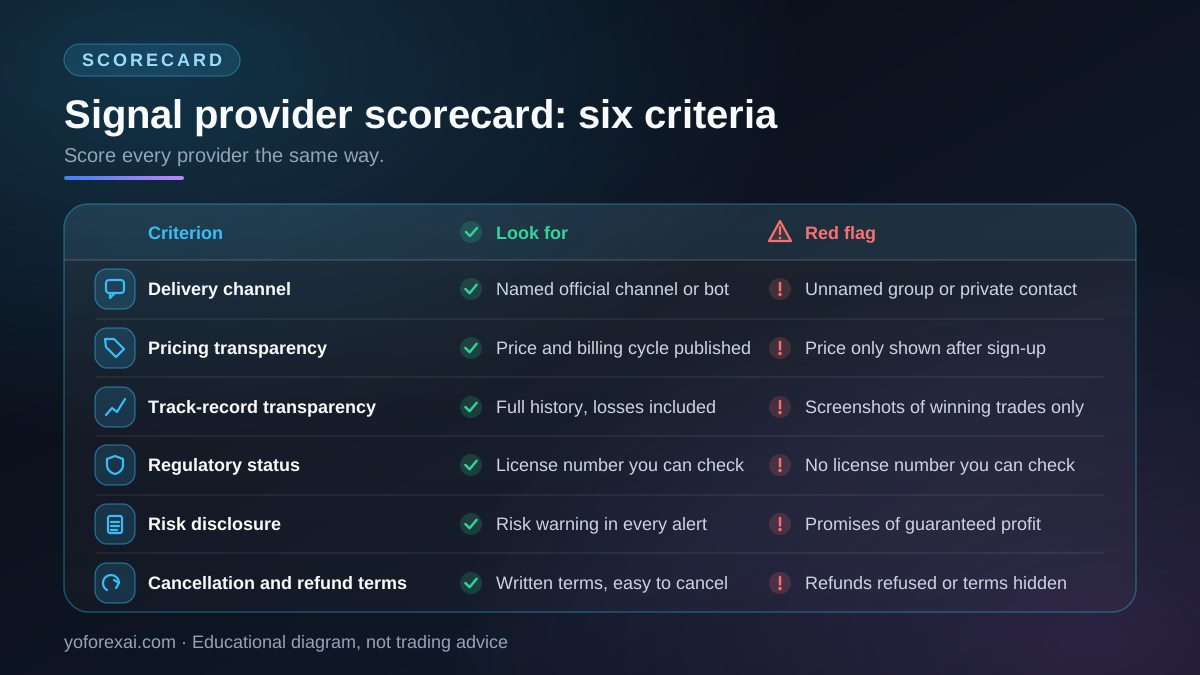
What should you check in a signal provider?
| Criterion | Look for | Red flag |
|---|---|---|
| Delivery channel | A clear description of where signals arrive, such as an app, a dashboard, email, or an alert, with the account type stated. | Access only through an unnamed group, or a channel whose operator is not identified. |
| Pricing transparency | Current prices on the provider’s own site, what each plan includes, and the billing period. | Prices given only in private messages, or a “lifetime” offer with no written terms. |
| Track-record transparency | Results with a stated period, instruments, account size, and losing trades included. | Screenshots only, a gallery of best trades, or returns with no period or account details. |
| Regulatory status | A registration you can look up on your own regulator’s public register. | No registration, or a claim of regulation you cannot find on the regulator’s site. |
| Risk disclosure | A plain statement that losses can be substantial, that past results do not predict future ones, and that you make the decision. | “Risk-free”, “guaranteed”, or “no-loss” wording. |
| Cancellation and refund terms | Written steps to cancel, any notice period, and the refund rules that apply. | Terms that change after you pay, or terms you can only find in a chat. |
Do not add the results into one total. A provider can be open about price and still have no verifiable record. Note the gaps. A missing item is information, and it is often the most useful one.
Why is a track record hard to verify?
Track records are the most abused part of signal marketing. A selective screenshot, a result with no account size, or a return figure with no period tells you very little. Ask for the full trade history, including losing trades, the account size used, and the period covered. Then ask whether the figures come from a broker statement. Even a complete record can reflect a favorable market period. Treat any headline return as a claim to verify, not as a fact. Our guide to evaluating a forex EA explains which report fields matter, and the same questions apply to signal records.
Who regulates the provider?
Regulation depends on where the provider operates and where you live. Rules differ by country, so check your own regulator first. Public registers give a starting point. The UK Financial Conduct Authority tells consumers to check a firm on its Firm Checker before investing and to confirm the firm reference number and contact details. The FCA also warns that unregulated investments offer no protection if something goes wrong. In the United States, the National Futures Association’s BASIC system is a free tool for researching the background of derivatives industry professionals. Securities brokers and investment advisers can be searched on FINRA BrokerCheck.
A registration number proves only that a firm or person is registered. It does not show that signals are accurate or suitable for you. Check that the registered name matches the name on the website, the app, and the payment receipt.
Which questions should you ask any provider?
Put these questions in writing before you pay. A reputable provider can answer them without difficulty. If it cannot, that is a finding in itself.
- Which legal entity operates the service, and what is its registered name and address?
- Which regulator authorized you, and what is the registration number I can check?
- Can you send the full trade history for a stated period, including the losing trades?
- What does each signal include: instrument, direction, entry, stop, target, size, and reasoning?
- Which broker, account type, and account size do your published results use?
- How do cancellation, refunds, and billing changes work, and where is that written down?
What are the common red flags?
Fraud and high-pressure selling often follow a recognizable pattern. The Telegram forex signals checklist covers the warning signs in more detail. The most common ones are these.
- A promise of guaranteed or risk-free profit.
- Pressure to pay quickly, or to upgrade before you have read the terms.
- Unsolicited contact from an “account manager”, or a message from a stranger in a group.
- A request for a password, a broker login, a one-time code, or remote access to your computer.
- Payment only by crypto transfer, gift card, or a personal account.
- Results shown only as images, with no dates, account details, or losing trades.
The FCA’s consumer guidance makes the same point in plain terms. An offer that sounds too good to be true usually is. Stop, check the firm, and do not send money while you are being pressed to act.
Where does YoForex AI fit?
YoForex AI is our product. We are not neutral about it, so treat this section as a disclosure rather than a recommendation. YoForex AI provides AI forex chart analysis for review, along with MT5 expert advisors. It is not a ranked item on this page, and no other provider is ranked against it here.
The free plan allows 5 AI analyses per day and lists access to several free AI models. The features page shows a Pro plan at $69 per month and a Max plan at $139 per month as of 7 November 2026. Confirm current prices and terms with support before you pay. AI analysis can be wrong, and models can disagree with one another. Alerts can be delivered to the dashboard, Telegram, or WhatsApp. An alert is information for you to review. Read more on our Telegram and WhatsApp alerts page and compare the plans on the features page. The free plan also lists public Discord and Telegram channels. Apply the operator check above before you join any channel.
Apply the six criteria to us as you would to anyone else. Check what you receive, how it is priced, whether the operator is identifiable, and how to cancel.
Should you use signals or an automated tool?
Signals and automation solve different problems. A signal is an idea for a person to review. An expert advisor is software with defined rules that can place or manage trades in MetaTrader. The comparison of forex signals and expert advisors explains the workflow differences, the account requirements, and who executes trades in each case. Choosing between them does not remove the need for the six checks above.
Does any provider remove the risk?
No provider removes the risk of forex trading. Leveraged forex can lose money quickly. A signal is one input among several. Your position size, stop placement, costs, and decisions determine the outcome. Test any service on a demo account before you commit money, and use only funds you can afford to lose. A good record in the past does not guarantee a good result in the future, and a clear risk statement is a minimum requirement, not a sign of quality.
Key takeaways
- There is no single best forex signal provider. Compare services on the same criteria.
- Check the provider’s registration on your own regulator’s public register. Rules differ by country.
- Ask for the full trade history, including losing trades, with the account size and period stated.
- Treat guarantees, pressure to pay, and requests for logins or codes as serious warning signs.
- YoForex AI is our product and is not ranked. Apply the same criteria to it.
Frequently asked questions
Is there a best forex signal provider?
No single provider suits every trader. Suitability depends on your experience, your costs, your regulator, and how much risk you can accept. Use the criteria on this page to compare the services you are considering.
Are free forex signals safe to use?
Free offers often lead to paid upgrades or private groups. Before you join anything, confirm who operates the service, whether it is registered, and whether the person sending messages can be verified. Never share a broker login, password, or one-time code.
Do forex signal providers have to be regulated?
The answer depends on the country. Some providers are authorized by a regulator and some are not. Check your own regulator’s register. An unregulated service may offer no regulatory protection if something goes wrong.
How can I verify a signal provider’s track record?
Ask for the full trade history for a stated period, including losing trades, and the account size and broker used. Compare the figures with broker statements where possible. A demo test of your own is a better check than a screenshot, but it is still not proof of future results.
Should I follow signals or use an expert advisor?
Signals provide ideas for you to review. An expert advisor follows programmed rules and can place or manage trades. Each needs its own checks. The signals versus expert advisors guide sets out the differences in more detail.
Sources and verification
Primary-source links used for the platform behavior and risk statements in this guide. Sources reviewed 7 November 2026.
- UK Financial Conduct Authority: Protect yourself from scams · Reviewed
- National Futures Association: BASIC background search · Reviewed
- FINRA: BrokerCheck · Reviewed