YoForex AI educational guides
Supertrend Indicator: How the ATR Band Is Built, When It Flips, and Its Limits
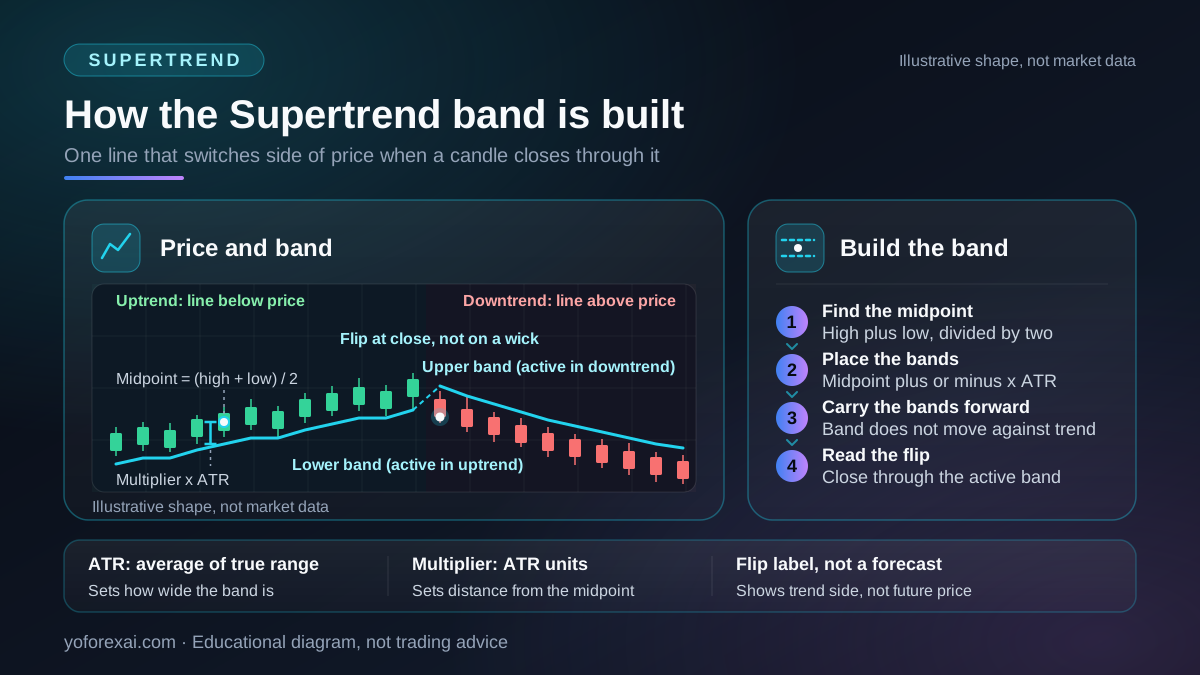
The Supertrend indicator is a trend-following overlay that places a band around each bar's midpoint, sized by the average true range (ATR). The band sits below price in an uptrend and above it in a downtrend, and it switches sides when a candle closes through it. It labels trend direction, not future price. It lags by design.
Published · Updated · By YoForex AI Editorial Team
The Supertrend indicator draws one line over your candles. Each bar updates the line using a fixed formula, so two traders with the same settings and the same bar data should see the same line. The line does not predict where price goes next. It records which side of the band the last close landed on, and that is all it does. This guide explains how the band is built from ATR, what each input changes, how to read a flip, and why the tool cannot show more than that.
What does the Supertrend indicator show?
The Supertrend indicator is a trend-following overlay. It is plotted on the price chart, not in a separate panel, and it behaves like a trailing line. In an uptrend, the line sits below price and rises as price rises. In a downtrend, it sits above price and falls as price falls. When price closes through the line, the line jumps to the other side of price and the trend label changes. That jump is called a flip.
How is the Supertrend band calculated from ATR?
The band depends on the average true range. MetaQuotes describes the MetaTrader 5 Average True Range indicator as one that “shows volatility of the market,” and says it is a moving average of true range values. Its Average True Range help page gives the definition. The average is a measure of how far price typically moves per bar. It is not a direction measure, and it does not use volume.
Most published Supertrend versions use the same three steps:
- Find the midpoint of each bar, which is the high plus the low, divided by two.
- Add and subtract a multiple of the current ATR value to that midpoint. The upper basic band is the midpoint plus the multiplier times ATR. The lower basic band is the midpoint minus the multiplier times ATR.
- Carry the bands forward so that they do not move against the trend. The lower band of an uptrend is not lowered, and the upper band of a downtrend is not raised. The active line is the lower band in an uptrend and the upper band in a downtrend.
Step 3 is what makes the line look like a trailing stop. The exact carry-forward rule varies between published versions, so read the code of the version you use before you rely on its output.
Hypothetical example (made-up numbers). Suppose a bar has a midpoint of 1.1000, the ATR value is 0.0020, and the multiplier is 3. The band distance is 3 times 0.0020, which is 0.0060. The upper basic band is 1.1060 and the lower basic band is 1.0940. If the trend is up and the lower band is active, a close below 1.0940 is the flip condition in this example. The numbers are invented to show the arithmetic, not a market reading.
What inputs does the Supertrend indicator use?
Most versions expose two inputs and a timeframe. The table shows what each one controls and what happens when you increase it. Each version sets its own defaults, so the default column says only where the value comes from. No official source gives a default, and no test shows that one setting is best for a given pair.
| Input | What it controls | Default | Effect of a larger value |
|---|---|---|---|
| ATR period | How many bars are averaged to get the ATR value. | Set by the version's author; no official default | A smoother ATR that reacts more slowly to volatility changes. |
| Multiplier | How many ATR units the band sits away from the midpoint. | Set by the version's author; no official default | A wider band, so fewer flips and a later reaction to price. |
| Timeframe | The bar size the line is calculated on. | Your chosen chart timeframe | Fewer flips and a slower signal, with each flip covering more time. |
Because the band width is a multiple of ATR, it widens in volatile periods and narrows in quiet ones. Changing the multiplier alters how often the line flips. It does not change what the market did. A test that adjusts the inputs until the results look good is a curve fit, and it should be labelled that way.
How do you read a Supertrend flip?
A flip is a change in the trend label that the formula assigns to the chart. Read it with the same discipline you would apply to any rule-based chart tool:
- Note the side of price. A line below price is an uptrend under this rule. A line above price is a downtrend.
- Wait for the close. A wick through the line is not a flip. The flip condition in most versions is a close through the active band.
- Log the time and timeframe. A flip on a five-minute chart and a flip on a daily chart are different events, and they should be counted separately.
- Check a higher timeframe. A downtrend flip inside a higher-timeframe uptrend has a different context from one that agrees with it.
The flip is a state change, not a target. It does not tell you the distance of the next move.
Is Supertrend built into MetaTrader 5?
Supertrend is not in MetaQuotes' trend indicators list as of 9 November 2026. The MetaTrader 5 trend indicators help index lists 13 trend tools, from Adaptive Moving Average to Variable Index Dynamic Average. Supertrend is not one of them, and neither is Keltner Channel. We did not check the other sections of the MetaQuotes indicator help, so this statement covers the trend list only. ATR appears in the oscillator section of that help.
If your platform does not list Supertrend, it runs as a custom indicator, which someone wrote in MQL5 or supplied from another source. Treat that file the way you would treat any program on your account. Read the source code, confirm who wrote it, and check whether it redraws old bars before you put it on a chart you trade from. If you cannot read the code, do not rely on the output.
If you build your own version in MQL5, ATR values are available through the iATR function. The MQL5 documentation says the function returns the handle of the Average True Range indicator, and that the averaging period is set by the ma_period parameter.
How does Supertrend compare with Keltner Channel and moving averages?
The table separates three tools that are often confused by what they are built from and what they output. The Keltner Channel guide covers that tool, and the moving-average basics are in the EMA and SMA guide.
| Tool | Built from | What it outputs |
|---|---|---|
| Supertrend | ATR added to and subtracted from the bar midpoint, carried forward | One line that switches side of price when a close crosses it |
| Keltner Channel | A midline and two bands; its construction is covered in the Keltner Channel guide | A midline and two bands, not a single flipping line |
| EMA crossover | Two exponential moving averages of closing prices | Two lines; the crossover is a rule you define yourself |
The practical difference is the flip. Supertrend gives you a single label that changes, while Keltner and moving averages give you levels to compare with price. Each gives a different kind of error. A label that changes is easy to read but can change often in a range. A set of bands can be read in more than one way, so the rule you write has to say which reading counts.
What Supertrend cannot tell you
Supertrend is a trend-labelling rule, and its limits are the limits of any lagging, volatility-scaled line. Read these before you use it as a trade input:
- It lags. Most versions calculate the band from closed bars. A flip usually comes after part of the move has happened.
- It whipsaws in ranges. When price moves sideways around the band, the line can flip back and forth. Each flip can look like a new trend in hindsight and still lose money when traded.
- Some versions repaint. A version that recalculates the current bar can change its last value before the bar closes. Test on closed bars only, and record each flip as it prints.
- The band depends on your feed. ATR uses the high, low and close of each bar. Different brokers record different highs and lows, and the symbol and session change the bar data. Two charts with the same settings can show slightly different lines.
- It is not a forecast. A history of flips does not show the expected return of the rule, and an AI tool that names a Supertrend level has not tested that level for you.
To test a Supertrend rule, write the inputs, the timeframe, the flip condition and the exit rule first. Record every flip, including the ones you would have skipped, and include spreads and swap. The guide to evaluating a forex EA covers how to structure that test, and the paper trading guide explains why a demo record still differs from live fills. If you read charts with an AI tool, such as YoForex AI (our product), check any band or trend label against your own chart and timeframe before you rely on it. The AI forex chart analysis guide lists the checks.
Risk warning. You can lose more than you deposit, depending on your broker and country. Forex trades can be made with leverage, which magnifies losses as well as gains. A flip that would have worked on past charts does not show that the rule will work next time. Check the rules that apply to you with your own regulator or local authority before you trade any setup.
Key takeaways
- The Supertrend indicator is a single line that sits below price in an uptrend and above it in a downtrend, and flips when a close crosses it.
- The band is the bar midpoint plus or minus a multiplier times ATR, carried forward so it does not move against the trend.
- Supertrend is not in MetaQuotes' trend indicators list. Check the source of any custom file you use.
- The ATR period and multiplier are set by each version's author, with no official default. Test any change on closed bars and record every flip.
- A flip labels trend direction. It does not forecast price, and it lags by design.
Frequently asked questions
Is Supertrend a built-in MetaTrader 5 indicator?
Not according to the MetaQuotes trend indicator help index we checked on 9 November 2026, which lists 13 tools and does not include Supertrend. Check your own platform, because a custom file may be installed on your terminal or supplied by a third party.
What are the default Supertrend settings?
Each version sets its own ATR period and multiplier, and no official source gives a default. Test any setting on closed bars, and do not treat a setting as correct because it is common.
Does the Supertrend indicator repaint?
It depends on the version. Some versions recalculate the latest bar while it is still forming, so the last flip can change before the candle closes. Read the code, or test the version on closed bars and compare the logged flips with the chart afterwards.
Can I use Supertrend as a stop-loss level?
You can use the band as a reference level, but a stop belongs to your risk rules. A band moves with ATR, so it can sit far from your entry in a volatile market. Size the position so that the loss at that distance is an amount you have decided in advance.
How is Supertrend different from Keltner Channel?
Supertrend is one line that switches side of price when a close crosses it. Keltner Channel is a midline with two bands, and the Keltner Channel guide explains how those bands are built.
Sources and verification
Primary-source links used for the platform behavior and risk statements in this guide. Sources reviewed 9 November 2026.
- MetaQuotes: Average True Range · Reviewed
- MetaQuotes: Trend Indicators · Reviewed
- MetaQuotes: iATR · Reviewed