YoForex AI educational guides
ORB Trading Strategy: Rules, Session Opens and Testing Limits
The opening range breakout (ORB) strategy marks the high and low of a fixed period after a session open, then trades a close beyond one of those levels. Forex has no single official open, so the session and range length must be written down as rules. It is a rule set you can test, not a proven method.
Published · Updated · By YoForex AI Editorial Team
What is the ORB trading strategy?
The ORB trading strategy, short for opening range breakout, is a named rule set. It marks the high and low of a fixed time window that starts at a chosen session open. It then waits for a candle to close beyond one of those two levels and trades in that direction. Traders apply the idea to stocks and futures, where the exchange open is a clear event. Forex has no exchange open, so the first step is choosing a session start yourself.
Many search results call this the orb strategy, and the name is used loosely. Some sources describe a range of five minutes, others an hour. Some require a close, others accept a touch. The strategy is easy to describe and harder to test well, because the description leaves out the session time, the length of the range, the entry trigger, the stop and the exit. Each of those choices changes the results. A useful write-up sets all of them before the test starts.
Which session open should you use in forex?
Forex trades around the clock on weekdays, across regional sessions. The starts traders most often reference are Tokyo, London and New York. Each start is a convention, not an official exchange open, so your rule should name the exact clock time it uses. Make sure that clock is the same one your chart uses for its bars, and confirm the offset with your broker before you write a time into the rule.
Session open times shift when daylight saving changes in some countries, and the change does not always happen on the same day everywhere. If your rule depends on a session start, check your broker’s server time against your local time before you test, and again when the clocks change. Note any change in your test log.
| Session open | How it is often used in an ORB rule | What to confirm before testing |
|---|---|---|
| Tokyo open | A reference for range breakouts during the Asian session. | The clock time on your chart, and which pairs you include. |
| London open | A reference for the start of European trading. | Whether your clock moves with UK daylight saving, and when. |
| New York open | A reference for the start of US trading. | Whether scheduled economic releases fall inside your range window. |
| A fixed time you choose | A custom reference that fits your own schedule. | A written reason for the time, and a test run on the same clock. |
What are the rules of an ORB setup?
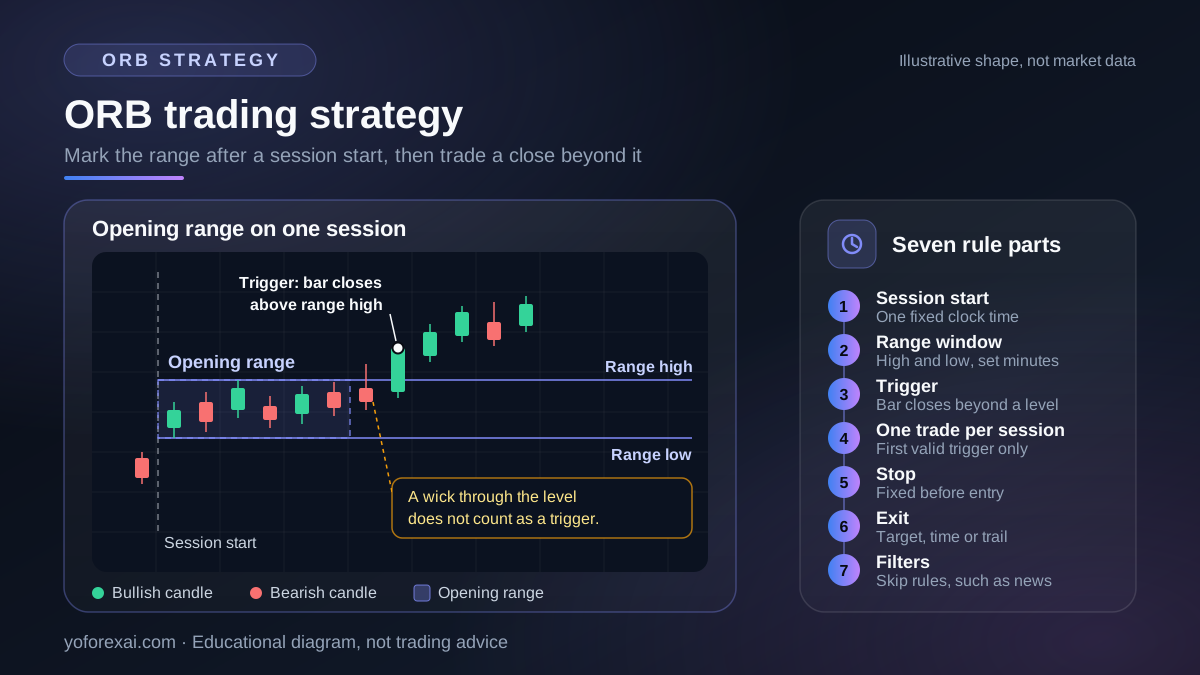
A rule set you can test has seven parts. Write each one as a sentence that another person could follow without asking you a question. If a part is missing, the test will fill the gap with a choice you did not make on purpose.
- Session start. One clock time, in one time zone, written into the rule.
- Range window. The high and low of the first set number of minutes after that start, for example 30 or 60, measured on one fixed timeframe such as five-minute bars.
- Trigger. A bar that closes above the range high for a long, or below the range low for a short. A wick through the level does not count.
- One trade per session. Take only the first valid trigger in the session, and state what happens after a stop.
- Stop. A fixed level set before entry, such as the opposite side of the range.
- Exit. A fixed target, a time exit at the end of the session, or a trailing rule. Pick one and test only that one.
- Filters. Any skip rules, such as a maximum range width, or no trading in a set window around a scheduled news release.
Hypothetical example, not a trade recommendation. Suppose a rule uses a 30-minute range on five-minute bars after a London start, on a EURUSD chart from a broker that quotes four decimal places. In this made-up case the range high is 1.1000 and the range low is 1.0960. The range is therefore 40 pips, since one pip is 0.0001 on that quote. A five-minute bar closes at 1.1012, which meets the long trigger in rule 3. If the stop sits at 1.0960 under rule 5, the distance from entry to stop is 52 pips. The rule fixes that distance. It does not set the money at risk, which depends on your position size.
How should you test an ORB rule set?
Testing an ORB rule set has two stages: a historical run, then a forward run on data that came after the rules were fixed. MetaQuotes describes the forward option in the MT5 Strategy Tester help as a way to check results “in order to avoid fitting to certain time intervals.” The general backtest method, including the tester settings and the forward option, is covered in the evaluation steps in the evaluate forex EA guide. The checks below are specific to an opening-range rule.
For each ORB test, vary and record these four settings:
- Session open. Test the session start you chose, and at least one neighbouring clock time, so you can see whether the result depends on the exact start.
- Range length. Test a small fixed list of window lengths, such as 15, 30 and 60 minutes, and report every one, not only the best.
- Breakout buffer. Decide whether a trigger needs a fixed distance beyond the range level, and test with and without it. A buffer changes which bars count as a trigger.
- Time stop. Decide when an open trade is closed if no target or stop has been hit, and log how often that exit fires.
Then apply these habits to every run:
- (delete this line)
- Log every session, including the sessions with no trigger. Skipped days are part of the sample.
- Count the trades per setting. A handful of sessions cannot separate a rule from chance.
- Keep the session clock identical across all symbols you test, so the same time rule applies to each. (delete this line)
How does an Expert Advisor handle the same rules?
An Expert Advisor runs the rules it was coded with, on each tick or bar it receives. An ORB rule set coded as an EA still has the same seven parts. The code decides which candle counts as a close, which clock the session start uses, and how the stop is placed. Read the inputs and, where the author provides it, the source. Check each one against your written rules. A single input that uses a different clock can change the number of trades.
The forex expert advisor guide explains what an EA is and how it differs from a manual method. The evaluate forex EA guide covers how to test an EA before use, so this page does not repeat that workflow. Use this page to define the ORB rules, then use the evaluation steps for the EA itself.
A rule set is also only one part of a wider strategy. The forex trading strategies guide covers what a strategy needs in writing, including entry, exit and risk rules, and the main types, such as breakout and range strategies.
What the ORB strategy cannot tell you
An ORB test shows how one named rule set behaved on one symbol, under one set of settings, over one period. It does not show what the next session will do. It does not show that the first hour after a session start is a reliable edge. A breakout can fail, and price can move back into the range after the trigger. A rule that works on one pair can fail on another, and a rule that works in one year can stop working in the next.
The UK Financial Conduct Authority guidance on price graphs makes a point that applies here. It says the timeframe or data shown may be selected to support a particular viewpoint, and that past performance is not a reliable indicator of future results. A session chart that looks clean is one selected example, not the full record.
- The result depends on the session clock and the range length. Change either one and the trades change.
- A few sessions are not a sample, and a best window found by searching many windows is a fitted result.
- Bar-based tests cannot show the exact order of prices inside a bar.
- Scheduled releases and gaps around the open can move price beyond the range before a rule can act.
- Spreads can widen near the open, which changes fill prices. A demo account may not show the same fills.
Risk warning. You can lose more than you deposit, depending on your broker and country, when you trade leveraged forex products. A breakout rule that stops out often can lose money quickly, even after a clean test. Set your loss limits before any trade, using the forex risk control guide as a starting point, and check the rules that apply to you with your own regulator or local authority.
Key takeaways
- The ORB trading strategy marks a fixed range after a session start and trades a close beyond it.
- Forex has no single official open, so write the session clock and range length into the rule.
- A testable ORB rule set has seven parts: session, window, trigger, one trade per session, stop, exit and filters.
- Test the rules historically, then forward on a demo or paper record, and do not change them mid-test.
- A clean chart or a short backtest is one selected example. It does not guarantee future results.
Frequently asked questions
What does ORB stand for in trading?
ORB stands for opening range breakout. The term describes a rule set that trades a close beyond the high or low of a fixed window that starts at a chosen session open.
What is the best range length for an ORB strategy?
There is no single best length that this page can name. A fair test sets a small list of window lengths in advance, reports every result, and does not pick the one that looked best after the fact.
Is the ORB strategy profitable?
This page cannot say. A profit claim needs a recorded test, on stated data and settings, and even then a past result does not guarantee future results. Treat any claim without those details with caution.
Do I need an Expert Advisor to trade an ORB rule set?
No. You can apply written rules by hand, or code them into an EA. Manual trading makes it harder to record every session and every skipped trigger, so keep a log either way.
Can I use the ORB strategy on forex without a session open?
Not in the usual form. Because forex has no single official open, the rule has to name a session start or a fixed clock time. Without that choice, the range is not defined and the test cannot be repeated.
Sources and verification
Primary-source links used for the platform behavior and risk statements in this guide. Sources reviewed 9 November 2026.
- UK Financial Conduct Authority: Understanding price graphs · Reviewed
- MetaQuotes: Strategy Testing · Reviewed