YoForex AI educational guides
Forex market sentiment: sources, analysis steps and limits
Forex market sentiment is a read of how traders are positioned or how they feel about a currency pair, taken from sources such as broker client-position data, news tone and official positioning reports. It describes what participants are doing or saying. It is not a forecast of price.
Published · Updated · By YoForex AI Editorial Team
What is forex market sentiment?
Forex market sentiment is the overall position or mood of market participants toward a currency pair. In practice, traders read it from data that shows which way people are positioned, such as the share of open retail positions on a pair that are long or short. They also read it from news coverage, when the tone of headlines points one way or the other. Each source describes a group of participants at a point in time. None of them describes the whole market.
The same topic is searched as forex sentiment and as forex sentiment analysis. This page covers both. The first term is the reading itself. The second is the method you use to collect, define and test that reading. If you want the wider role of AI in trading tools, the what is forex AI guide sets out the basics.
Which sources show forex sentiment?
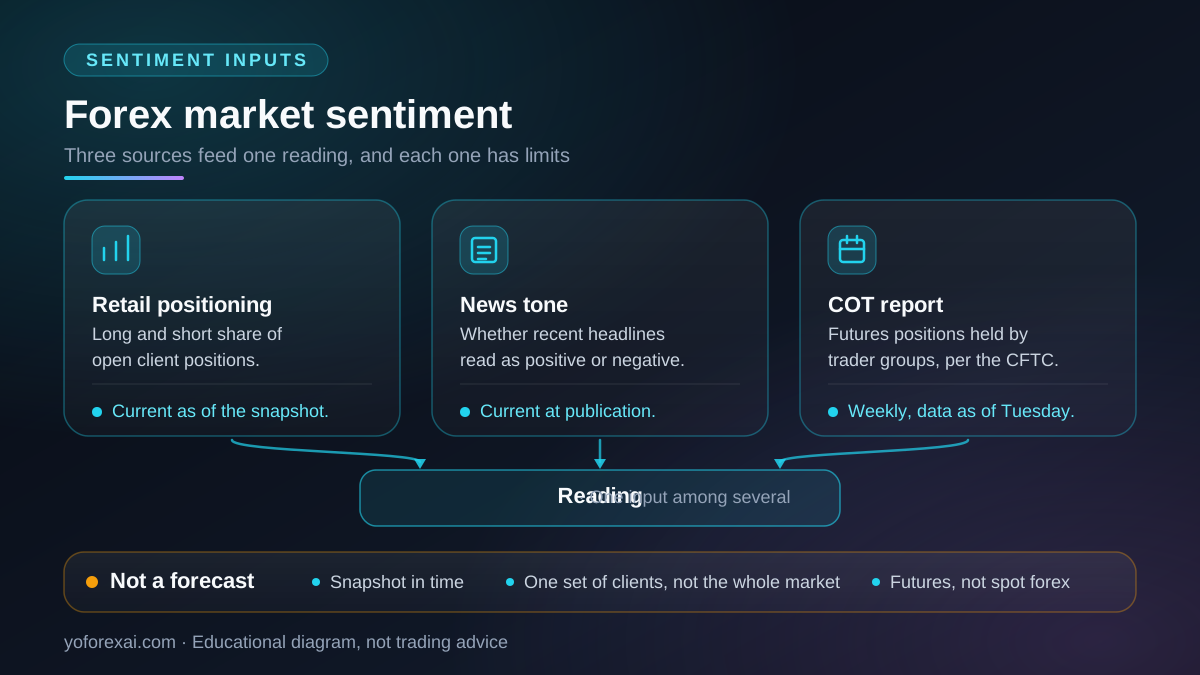
Three sources come up most often. They measure different things, they arrive at different times, and they fail in different ways. The table lists what each one shows, how current it is, and its main limit.
| Source | What it shows | How current it is | Main limit |
|---|---|---|---|
| Retail positioning | The share of open client positions on a pair that are long or short, from one broker or platform. | Current as of the snapshot. It can change within minutes. | One set of clients. It is not the whole market. |
| News tone | Whether recent headlines or reports read as positive or negative for a currency. | Current at publication. It can lag the price move. | Tone is a judgment. The same text can be labelled differently. |
| COT report | Positions held by groups of traders in futures and options on futures, as published by the CFTC. | Weekly. Data is as of Tuesday and released on Friday. | It covers futures markets, not spot forex. |
Retail positioning and news tone describe the trading crowd more directly, but each is narrow. The COT report is broad and official, but it describes a different market. Reading them together gives more context than trusting any one of them. Note the source and the timestamp for each reading, so you can tell later which one you used.
Does the COT report describe spot forex?
The CFTC publishes Commitments of Traders reports every week. The agency describes them as covering futures and options on futures markets. Traders are grouped by the business purpose they report, and the data is as of each Tuesday, with the release generally on the Friday afternoon. The CFTC page on the reports does not mention spot forex.
This means the COT report can tell you how futures traders in a currency contract were positioned on a given Tuesday. It cannot tell you how the spot pair your broker quotes is positioned today. A reading that is several days old describes that past date, not the chart in front of you. Label it as a futures reading when you write it down, and do not present it as a spot forex reading.
How does forex sentiment analysis work?
Forex sentiment analysis is a repeatable way to collect a sentiment reading and state what it means. The steps below keep the work checkable. Write them down before you look at a result, and keep the rules fixed while you test them.
- Name the source and the instrument. For example, a broker's client positioning on one pair, or a COT report for one futures contract. Record the source's timestamp.
- Define the measure as one number. That might be a share of long positions, a net count, or a tone label from a rubric you wrote.
- Fix the window. Decide how far back you will look, and record every reading in that window, not only the striking ones.
- Compare each reading with what price did next, and with your rules. Ask whether the test was done without hindsight, using only information that existed at the time of the reading.
- Record the outcome as a test result, not as a signal. A reading that looks clear after the move is hindsight, not evidence.
Hypothetical example. A broker snapshot taken at 10:00 shows 70 percent of client positions on a pair as long. The tone of that day's headlines is labelled negative. Both readings are time-stamped and saved. Over the next 20 sessions, you record whether price moved up or down after each snapshot. The numbers here are invented to show the format. They are not data from any market.
Where does AI fit in sentiment work?
AI models can help with the reading, not with the forecast. A model can summarize a set of headlines you paste in, group them by topic, or label each one as positive, negative or neutral against a rubric you supply. It can also turn a positioning table into a plain sentence. Each of these tasks depends on the text and the rubric you give it. Doing them does not give the model a live sentiment feed, and its label is only as good as the input.
Check the output the same way you check a chart read. Ask the model to quote the lines it used, then compare those lines with the source. A label without a quote is hard to audit, and a summary that leaves out the one headline that contradicts it is easy to miss.
YoForex AI is our product. It is an AI-assisted chart-analysis dashboard. You provide a chart, and it returns a suggested direction, entry, stop-loss and take-profit levels with the model's reasoning, for you to review. This page does not claim that YoForex AI reads sentiment data, and a suggested direction is not a forecast. For the chart side of this work, the AI forex chart analysis guide explains how to check a model's levels, and the features page lists what the product does.
What forex market sentiment cannot tell you
Sentiment is a description of participants. It does not tell you when price will move, how far it will move, or whether the crowd is right. The limits below apply to every source in the table above.
- A snapshot is one moment. Positioning changes during the session and after each scheduled release.
- One set of clients is not the market. A reading from one broker says nothing about the clients of other brokers.
- Crowds can stay on one side for a long time. An extreme reading can remain extreme while price keeps moving the same way.
- Tone depends on the rubric. Two readers can label the same headline differently, and a model can too.
- Data is often delayed. Check the timestamp before you use a reading. A scheduled release can fall between two of your readings, which the forex economic calendar guide covers.
The UK Financial Conduct Authority makes a general point about price graphs in its guidance on understanding price graphs. It says the timeframe or data shown may be selected to support a particular viewpoint, and that past performance is not a reliable indicator of future results. The same caution applies to a sentiment chart.
Risk warning. You can lose more than you deposit, depending on your broker and country. Forex trades can be made with leverage, which magnifies gains and losses alike. A trade placed because sentiment looks one-sided can lose money like any other trade. The forex leverage and margin guide explains the mechanics. Check the rules for leveraged products with your own regulator or local authority, because they differ by country.
Key takeaways
- Forex market sentiment describes how participants are positioned or how news reads. It is not a forecast of price.
- Retail positioning, news tone and the COT report each show a different slice, at a different time. None of them covers the whole market.
- The CFTC COT report covers futures and options on futures, not spot forex, and it is released weekly.
- Write down the source, timestamp, rule and window before you read a sentiment result, and score the result as a test.
- AI can label or summarize text you supply. Check its quotes, and do not treat a suggested direction as a forecast.
Frequently asked questions
What is the difference between forex sentiment and forex sentiment analysis?
Forex sentiment is the reading: how positioned or how positive a market looks at a point in time. Forex sentiment analysis is the method for collecting that reading, defining it with one measure, and testing whether it was useful over a fixed window.
Is it a good idea to trade against the crowd?
Not on its own. A crowd on one side of a trade is a hypothesis to test. Record the readings and what price did next over a set window, and check the result against a rule you wrote in advance.
Where can I find the CFTC Commitments of Traders report?
The CFTC publishes it on its Commitments of Traders page, weekly. The reports cover futures and options on futures markets, not spot forex, so label any reading you take from them as a futures reading.
Can AI tell me the current forex market sentiment?
An AI model can summarize or label text and tables that you give it. It does not provide a verified live sentiment feed by itself. Check its quotes against the source, and treat its output as one input among several.
Does sentiment data predict price?
This guide does not show that it does for any pair. Test any claim you read against dated data you record yourself, using rules fixed in advance, and accept the result when it is poor.
Sources and verification
Primary-source links used for the platform behavior and risk statements in this guide. Sources reviewed 9 November 2026.
- U.S. Commodity Futures Trading Commission: Commitments of Traders · Reviewed
- UK Financial Conduct Authority: Understanding price graphs · Reviewed