YoForex AI educational guides
Forex calendar: release dates, impact levels and news risk
A forex calendar is a schedule of economic releases and central bank events, such as inflation reports, jobs data and interest-rate decisions, that can move currency pairs. Each entry has a date, a currency and an impact rating. The calendar shows when news is due. It does not show the result or the direction of price.
Published · Updated · By YoForex AI Editorial Team
Traders use a forex calendar to see when economic releases are due, so they can plan for the moments when currency prices often move fastest. This guide explains what a forex calendar lists, how impact levels work, where the official release dates come from, and why spreads and fills change around news. It also covers how to check whether an expert advisor handles news, and what the calendar cannot tell you.
What does a forex calendar show?
A typical entry gives the release name, the currency or country, the scheduled time, and an impact rating. Many calendars also show a previous value and a forecast, then fill in the actual result once it is published. The fields differ between providers, so read the definitions before you rely on one.
The calendar is a list of dates, not a signal. Knowing that a release is due tells you when risk may rise. It does not tell you whether the figure will beat the forecast or how the market will react.
The MQL5 calendar documentation describes a built-in economic calendar for MetaTrader 5 programs. It lists functions such as CalendarEventByCurrency and CalendarValueHistory, and it says events carry an importance level. A program can read those values in code, which is useful when an expert advisor needs to check upcoming news.
Which releases carry high, medium and low impact?
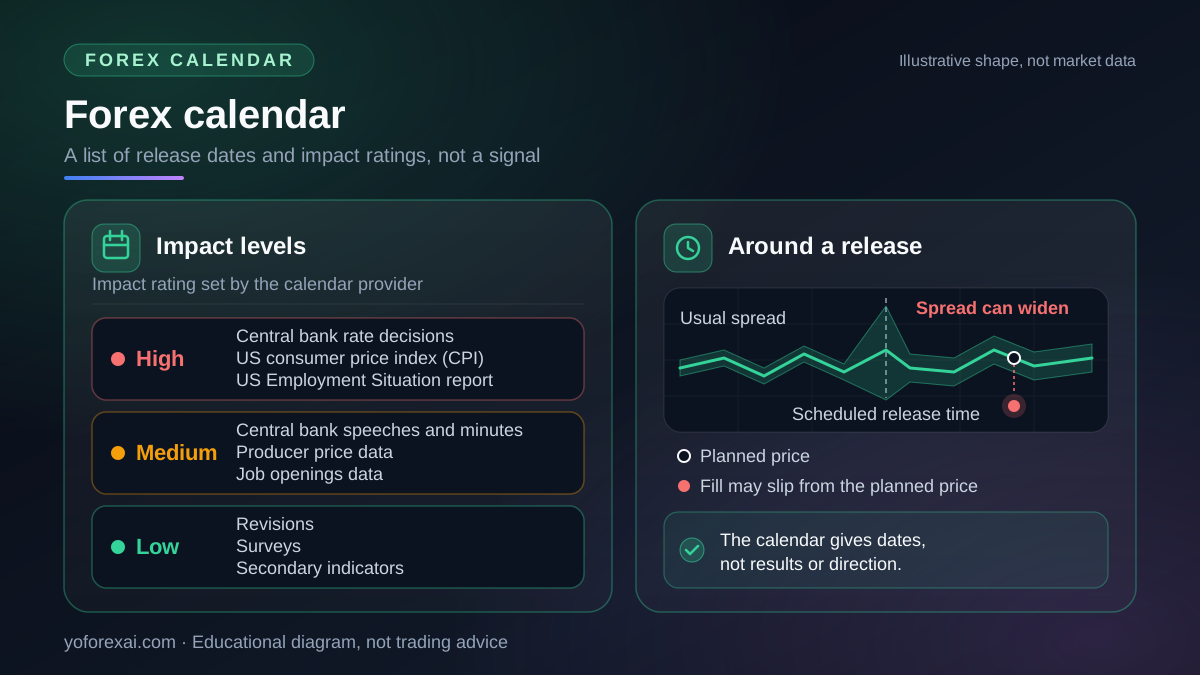
Impact labels differ between calendar providers, so the same release can carry a different rating on another calendar. Check how your provider defines high, medium and low before you use its ratings.
| Impact level | Typical examples | What to watch for |
|---|---|---|
| High | Central bank rate decisions and their press conferences; the US consumer price index (CPI); the US Employment Situation report. | Moves can be large here, and spreads may widen. Plan these first. |
| Medium | Other central bank speeches and minutes; producer price data; job openings data. | Moves are often smaller, but spreads can still change at the release time. |
| Low | Revisions, surveys and secondary indicators, depending on the provider. | Often little effect on price, but check the rating. Your provider may place any release in a different row. |
The BLS calendar for November 2026 lists the Employment Situation, Consumer Price Index, Real Earnings, Producer Price Index, Job Openings and Labor Turnover Survey, and Productivity and Costs releases. Those names are a useful starting point for a high or medium rating, but the rating itself is still the provider's decision.
Where do official release dates come from?
For US data, the Bureau of Labor Statistics release calendar lists publication dates for most of its news releases. BLS says the calendar is updated as needed, usually at least a week before a scheduled release, and its page explains how to copy the calendar file into a calendar app.
For Federal Reserve policy meetings, the FOMC calendar lists the 2026 meeting dates. They are 27 to 28 January, 17 to 18 March, 28 to 29 April, 16 to 17 June, 28 to 29 July, 15 to 16 September, 27 to 28 October and 8 to 9 December. Meetings that include a Summary of Economic Projections are marked on the page.
For euro area policy, the ECB publishes its Governing Council and General Council meeting calendar. The page covers November 2026 to December 2028, along with the related press conferences. Its December 2026 monetary policy meeting runs from 16 to 17 December, with a press conference on 17 December.
Check your own central bank and statistics agency too. Other countries publish their own calendars, and their dates can differ from the US and euro area examples above. These dates were checked on 9 November 2026. A calendar can change, so confirm each date at its source before you act.
Why do spreads widen and prices slip around releases?
The spread is the gap between the bid price, where you can sell, and the ask price, where you can buy. You pay the spread each time you open a position at market. Around a release, liquidity providers may widen their quotes while they wait for the figure, so the spread on your screen can be wider than usual.
Slippage is the difference between the price you requested and the price you receive. It can occur when the price moves between the moment an order is sent and the moment it is filled. A stop order is a common example. Once it is triggered, it may fill at the next available price, which can be worse than the stop level. Price can also jump past a level without trading at it, so the fill may be far from the price you planned.
Risk warning. You can lose more than you deposit, depending on your broker and country. Releases can move price and widen spreads within seconds, so a stop may fill further from your planned level than you expected. Check your broker's execution terms, and check the rules that apply to you with your own regulator.
How should you plan a trade around a release?
A plan written before the release is easier to follow than a decision made during it. The steps below are a checklist, not advice for any particular trade.
- Convert the release time into your broker's server time and into UTC. Check the time zone setting of the calendar, because a one-hour error changes the whole plan.
- Decide in advance whether you will hold through the release, wait for it to pass, or stay out. Write that decision down.
- Check open positions and pending orders. Confirm the stop and take-profit levels still match the risk you planned.
- Compare the current spread on the same symbol with its usual level before you place an order.
- After the release, wait for the first few candles to settle, then check whether the move matches your written rules.
Margin can change too. Brokers may change margin requirements, and a position that fits your margin before a release may need more margin during volatile trading. The leverage and margin guide explains how margin works and how leverage limits are set.
How do expert advisors handle news events?
An expert advisor follows the rules in its code and its inputs. It does not read the calendar unless its author built that behavior into the program. This guide does not state how any particular product handles news.
To check an EA, start with its documentation, then look at its input list in the MetaTrader 5 properties window. Look for any setting that mentions news, economic events, a pause window or a calendar. Then find out what the EA does when calendar data is missing or delayed. A setting that says it avoids news is not enough on its own. Confirm that the behavior works as described.
Test the setting on a demo account before you rely on it. A backtest can only show the news behavior that its data contains, so a clean backtest does not prove that a news filter would have worked on live prices. The EA evaluation guide covers testing in more detail, and the forex expert advisor guide explains what an EA can and cannot do.
What can a forex calendar not tell you?
A calendar is a schedule. It has the following limits:
- The result. The actual figure is unknown until it is published.
- The direction. A figure can beat the forecast and still push a currency lower, or the reverse. The calendar does not model the market reaction.
- The impact rating. Ratings come from a provider, and they can differ between calendars.
- Unscheduled events. Surprise announcements and breaking news do not appear in advance.
- Time zones and revisions. Some releases are revised later, and a wrong time zone can put you on the wrong side of an event.
To test your own news rules, use the paper trading guide to record each event and its outcome. Keep the rules fixed while you test them, and do not change them after a losing event.
Key takeaways
- A forex calendar lists scheduled releases and central bank events with dates, currencies and impact ratings.
- Impact ratings come from the calendar provider. Check how that provider defines high, medium and low.
- Official dates for US labor and price data, Federal Reserve meetings and ECB meetings are published by those institutions. Confirm each date at its source.
- Spreads can widen and fills can slip around releases, so a stop may fill far from the planned level.
- An expert advisor handles news only as its code and inputs say. Read its documentation and test the behavior on a demo account.
Frequently asked questions
What is a forex calendar used for?
Traders use a forex calendar to see when scheduled economic releases and central bank events are due, so they can plan positions and risk around those times. It shows dates and ratings. It does not show results or the direction of price.
Is a forex calendar the same as an economic calendar?
An economic calendar can cover many releases across many markets. A forex calendar is usually filtered to the releases that affect currencies and currency pairs, and some sites call that version a forex news calendar. The two overlap, and the filter and impact ratings differ by provider.
Which events move forex prices the most?
Central bank rate decisions and high-impact inflation and employment reports are often rated highest. The rating comes from the provider, though, and the market reaction depends on how the result compares with expectations, not only on the event itself.
Should I close trades before a major release?
There is no single answer. Some traders close positions before major releases, and others hold through them. Either choice carries risk, including wider spreads and slippage. Decide in advance, write the rule down, and check the rules that apply to you.
Do expert advisors avoid news automatically?
Only if the EA's code or inputs say so, and only if the behavior has been tested. Read the EA's documentation, check its inputs, and confirm the behavior on a demo account before you rely on it.
Where can I find official release dates?
Start with the agency that publishes the data. The BLS publishes US labor and price release dates, the Federal Reserve publishes its FOMC meeting calendar, and the ECB publishes its policy meeting calendar. Check your own central bank and statistics agency for other countries.
Sources and verification
Primary-source links used for the platform behavior and risk statements in this guide. Sources reviewed 9 November 2026.
- U.S. Bureau of Labor Statistics: Schedule of Selected Releases · Reviewed
- European Central Bank: Meetings of the Governing Council and the General Council · Reviewed
- Board of Governors of the Federal Reserve System: Meeting calendars and information · Reviewed
- MetaQuotes: Economic Calendar · Reviewed