YoForex AI educational guides
CFD trading explained: what a contract for difference is and how it differs from forex
CFD trading means trading a contract for difference: an agreement between you and a broker to exchange the change in an asset's price between opening and closing the position. You do not own the underlying asset. CFDs use leverage and margin, so gains and losses are magnified, and the rules for retail clients differ by country.
Published · Updated · By YoForex AI Editorial Team
What is CFD trading?
CFD trading is the practice of opening and closing contracts for difference, usually called CFDs. A CFD is a contract with a provider, normally a broker, that pays or charges you the difference between the price when you open the position and the price when you close it. The contract follows the price of an underlying asset, such as an index, a share, a commodity or a currency pair. You never receive the asset itself.
Because the contract tracks price, a CFD can usually be opened as a buy or as a sell. A trader who expects a fall can open a sell position, and a trader who expects a rise can open a buy position. Whether a given instrument can be sold, and what it costs to hold, depends on the terms the provider publishes for that instrument.
MetaTrader 5 shows those terms in each symbol's specification window. The window lists the contract size, which MetaQuotes describes as the number of units of the asset in one lot, along with margin and swap rates for buy and sell positions. The MetaQuotes Market Watch help page notes that the margin shown is calculated from the price when the window opens and is not updated in real time. Reopen the window before you calculate a position.
How does a CFD trade work?
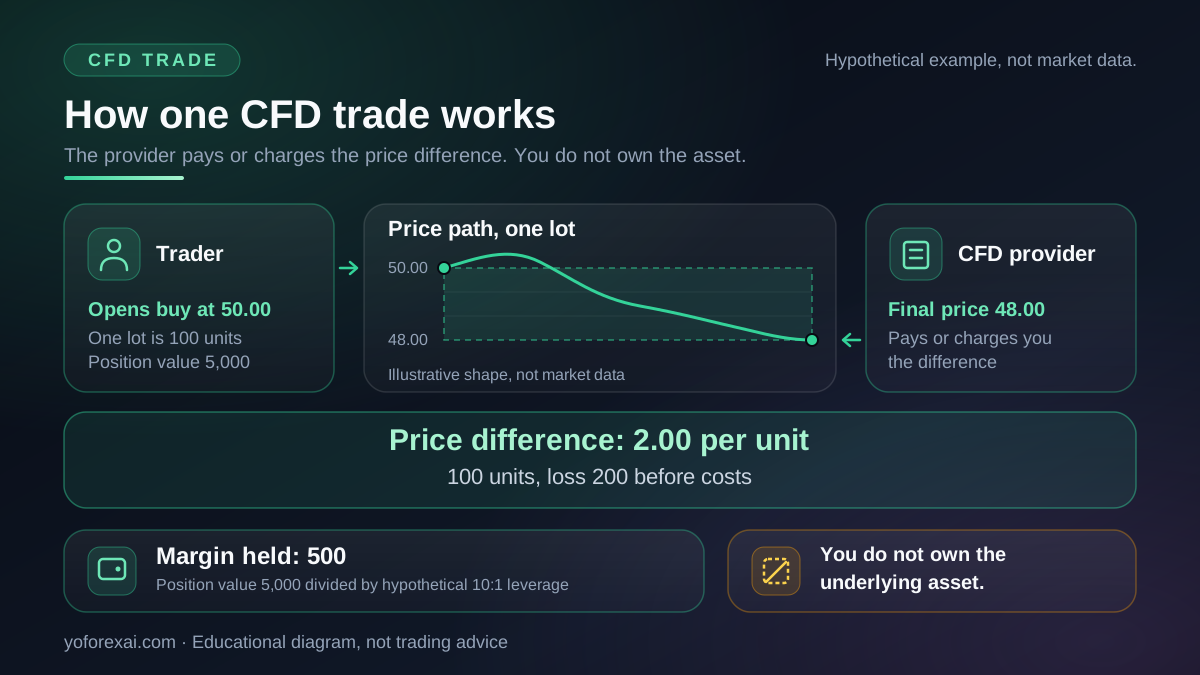
Take a hypothetical example with round numbers. One lot of a CFD has a contract size of 100 units and is quoted at 50.00. The position value is therefore 5,000, which is 100 units multiplied by 50.00. At a hypothetical leverage of 10:1, the margin needed to hold the position is 500, which is the position value divided by the leverage. The deposit is held against the position, and it is not a fee.
Suppose the price falls to 48.00 and you close the position. The price moved 2.00 against you on each unit, so the loss is 200 before costs, which is 40 percent of the margin in this example. If the price had risen to 52.00, the same arithmetic would give a gain of 200 before costs. The result depends on the direction of the move, the size of the position and the costs that apply.
Costs matter in the same way. A CFD provider usually builds a spread into its prices, and an open position can carry a financing or swap charge, depending on the instrument and the day. Those charges reduce any gain and add to any loss. Read them in the product terms before you open a position, not after.
How do CFDs differ from spot forex and futures?
CFDs are often compared with spot forex and with futures, because all three let a trader take a view on price without buying the asset outright. The differences are in the counterparty, the expiry and the cost structure. The table below sets them side by side. The details for any single product come from its own terms, so treat the table as a starting point.
| Feature | CFD | Spot forex | Futures contract |
|---|---|---|---|
| Underlying | Price of an index, share, commodity, currency pair or other asset. | Exchange rate between two currencies. | A commodity or financial asset, under a standard agreement. |
| Ownership | You do not own the asset. | You hold a currency position through your broker. | You hold a contract, not the asset. |
| Expiry | Usually none. The position stays open while margin is met. | No fixed expiry. An open position can carry a rollover charge. | A set expiry date, fixed by the exchange. |
| Costs | Spread and any financing charge, set by the provider. | Spread and any swap, shown in the symbol specification. | Commission and exchange fees, with the bid and ask spread. |
The table shows one point clearly. A CFD is an agreement with a provider, and a futures contract is a standard agreement that can be settled by delivery or closed out before expiry. The CFTC glossary defines a futures contract as an agreement to purchase or sell a commodity for delivery in the future. Spot forex sits in an over-the-counter market, which the same glossary describes as a market for foreign exchange transactions outside an exchange. Your broker's terms decide the details in each case.
How do leverage and margin apply to CFDs?
Leverage lets a position be larger than the cash in the account. Margin is the deposit that the provider holds against the position. A small move in price can therefore produce a large change in the value of your account, in either direction. The leverage and margin guide explains the arithmetic in more detail.
Retail rules limit how much leverage a provider may offer. In its policy statement PS19/18, the UK Financial Conduct Authority set rules for CFDs sold to retail clients. Firms must limit retail leverage to between 30:1 and 2:1, depending on the volatility of the underlying asset. Firms must close out a client's position when the funds in the account fall to 50 percent of the margin needed to keep the positions open. Firms must also provide protection so that a client cannot lose more than the total funds in the trading account. The FCA says these rules applied to CFDs from 1 August 2019. Those limits are UK rules. Other countries set their own limits. The FCA's policy statement PS19/18 sets out the full rules.
What are the main risks of CFD trading?
Risk warning. You can lose more than you deposit, depending on your broker and country. Some regulators require negative balance protection for retail clients, as the FCA does in the UK, but that protection is not the same everywhere. Whether retail clients can trade CFDs, and on what terms, depends on the country, so check your own regulator before you open an account.
The main risks are these:
- Leverage magnifies moves. The same margin that lets you hold a large position also means a small adverse move can cost a large share of your deposit.
- Costs reduce returns. Spreads and financing charges are paid whether a trade wins or loses, so a position needs to move far enough to cover them.
- A stop order is not a guaranteed exit. In a fast market, a stop can fill at a worse price than the level you set.
- Your result depends on the provider. Prices, execution and the handling of margin calls come from the provider, so check its regulatory status and its published terms.
How do you check a CFD before you trade it?
- Open the specification for the instrument and note the contract size, the margin requirement, and the swap rates for buy and sell positions.
- Work out the position value and the margin for the size you plan to trade. Then calculate the loss at your stop level, including the spread.
- Confirm that the provider is authorized by the regulator in your own country, and read its negative balance and margin close-out terms.
- Test the rules first on a demo or paper record. The paper trading guide explains what those tests can and cannot show.
What can a CFD definition not tell you?
This guide explains what a CFD is and how the main terms work. It does not say whether any CFD, instrument or strategy will be profitable. Results depend on the price path, your position size, your costs and your own decisions. It also does not give a share of retail clients who lose money. Published figures vary by regulator, year and sample, and none is verified here.
Automated systems do not change the terms of a CFD. An expert advisor can place orders, but the margin, costs and risks are set by the instrument and the provider. The forex expert advisor guide covers what an automated system does and does not do. Product rules differ between providers, so use the specification of the instrument you trade, not a general description. If you are new to the market, the guide to starting forex trading covers the basics before you add any product with leverage.
Key takeaways
- CFD trading uses contracts for difference, which pay or charge the price change between opening and closing a position.
- You do not own the underlying asset when you trade a CFD, and a CFD can usually be opened as a buy or a sell.
- Leverage and margin magnify both gains and losses, and the costs of a position reduce any gain.
- CFDs differ from spot forex and futures in counterparty, expiry and costs, so compare the specific terms of each product.
- Rules for retail clients differ by country. Retail access to CFDs depends on the country, and the UK sets its own leverage and close-out limits.
Frequently asked questions
Is CFD trading the same as forex trading?
No, but the two overlap. A CFD can be offered on a currency pair, so you can trade the pair through a CFD. Spot forex is a currency exchange, and a CFD on the same pair is a contract with a provider. The costs, expiry and rules can differ between the two.
Do you own the asset when you trade a CFD?
No. You hold a contract that follows the price of the asset. You receive the price change, not the asset, and you do not get the shareholder or commodity rights that come with ownership.
Can you lose more than your deposit with CFDs?
Depending on your broker and country, yes. Some regulators require negative balance protection for retail clients, which stops a client from losing more than the funds in the account. Check the protection that applies to your account before you open a position.
Are CFDs allowed for retail traders everywhere?
No. Whether retail clients can trade CFDs depends on the country, and regulators set their own leverage and margin rules. Check the rules with your own regulator or local authority before you open an account.
What is the difference between a CFD and a futures contract?
A futures contract is a standard agreement with a set expiry date, and it is commonly traded on an exchange. A CFD is an agreement with a provider and usually has no fixed expiry. The table in this guide compares the two on underlying, ownership, expiry and costs.
Sources and verification
Primary-source links used for the platform behavior and risk statements in this guide. Sources reviewed 9 November 2026.
- U.S. Commodity Futures Trading Commission: Futures Glossary · Reviewed
- UK Financial Conduct Authority: PS19/18: Restricting contract for difference products sold to retail clients · Reviewed
- MetaQuotes: Market Watch · Reviewed